[WEBINAR] Europe’s toxic legacy: how historic landfills harm communities today
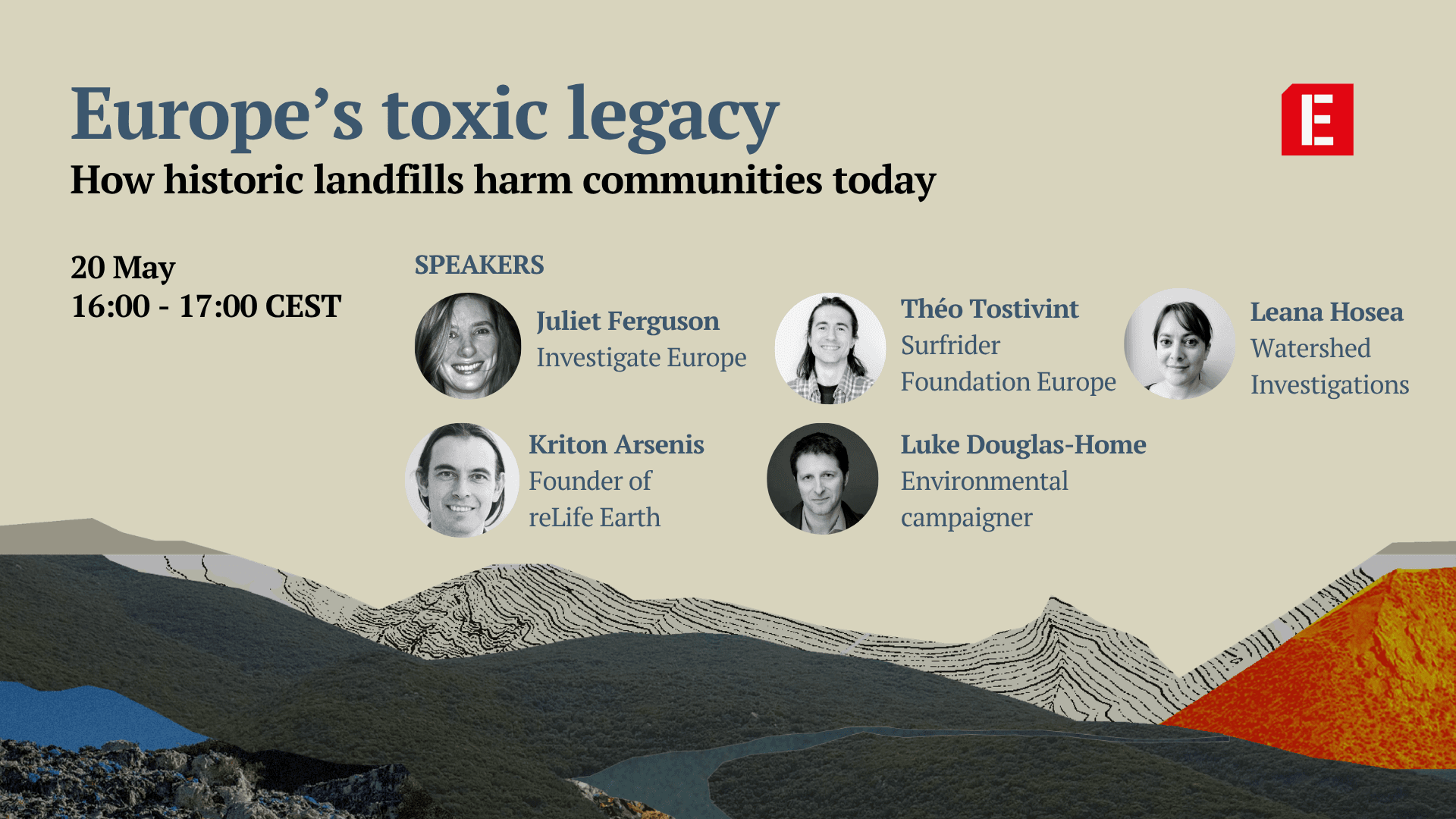

Join us for a live discussion about Toxic Ground, a cross-border investigation mapping more than 60,000 landfill sites across Europe for the first time. Journalists and environmental experts will discuss the hidden risks posed by historic landfill sites, the impact of climate change on vulnerable waste zones, and the regulatory failures leaving communities exposed across the continent. The webinar will also include a live Q&A with the audience.
Thousands of landfills across Europe are hidden in flood zones, near drinking water sources and inside protected conservation areas — posing serious risks to ecosystems and public health. Yet the true scale of Europe’s landfill crisis has remained largely invisible.
That is why we launched Toxic Ground, a groundbreaking cross-border investigation mapping more than 60,000 landfill sites across Europe for the first time. Now we want you to join us in our upcoming webinar, where journalists and environmental experts will discuss the investigation’s findings, the dangers posed by historic landfill sites and the urgent questions Europe must confront. This is also the opportunity for you to put your questions to our panel about the investigation’s findings.
Toxic Ground is a major investigative project led by Investigate Europe and Watershed Investigations that reveals the hidden environmental threats linked to Europe’s landfill legacy.
Drawing on data obtained through Freedom of Information requests, government agencies and public records, reporters mapped more than 60,000 landfill sites across Europe — many of them historic dumps established before modern environmental protections existed.
The investigation uncovered thousands of landfills located in flood-risk zones, coastal erosion areas, drinking water protection zones and protected conservation sites. The project also exposed how the absence of consistent EU-wide mapping and monitoring has left communities across Europe unaware of the risks beneath their feet.
That is why we launched Toxic Ground, a groundbreaking cross-border investigation mapping more than 60,000 landfill sites across Europe for the first time. Now we want you to join us in our upcoming webinar, where journalists and environmental experts will discuss the investigation’s findings, the dangers posed by historic landfill sites and the urgent questions Europe must confront. This is also the opportunity for you to put your questions to our panel about the investigation’s findings.
What is Toxic Ground?
Toxic Ground is a major investigative project led by Investigate Europe and Watershed Investigations that reveals the hidden environmental threats linked to Europe’s landfill legacy.
Drawing on data obtained through Freedom of Information requests, government agencies and public records, reporters mapped more than 60,000 landfill sites across Europe — many of them historic dumps established before modern environmental protections existed.
The investigation uncovered thousands of landfills located in flood-risk zones, coastal erosion areas, drinking water protection zones and protected conservation sites. The project also exposed how the absence of consistent EU-wide mapping and monitoring has left communities across Europe unaware of the risks beneath their feet.
Webinar details
- Title: Europe’s toxic legacy: how historic landfills harm communities today
- Date: Wednesday, 20th May
- Time: 16:00 / 17:00 CEST
- Platform: Zoom
Speakers
Juliet Ferguson
Juliet Ferguson is a founder member of Investigate Europe. With a career spanning print, digital, and broadcast media, she has reported on a wide range of topics including politics, social justice and international affairs.
Notable recent investigations include a major cross-border investigation mapping over 60,000 landfill sites across Europe, highlighting environmental and public health risks, a look at how women’s argan oil producing co-operatives in Morocco are being pushed to margins and an in-depth look at how EU countries continue to subsidise fossil fuels undermining climate goals.
Her work with the Centre for Investigative Journalism (CIJ) is a significant part of her career, and is focused on training and supporting other journalists rather than publishing investigations directly.
Much of her early career was spent at the BBC, her last role for the corporation was senior broadcast journalist at Panorama, the BBC’s flagship investigative current affairs programme
Leana Hosea
Leana Hosea is an investigative journalist and co-founder of Watershed Investigations, a nonprofit unit publishing and broadcasting water-focused investigations in mainstream media.
Watershed has created content for the Guardian, BBC radio and TV, ITV, the Times, Daily Mail, etc. Their open-source ‘Pollution Map’ was nominated at the British Journalism Awards. They have also won the Association of British Science Writers ‘Best Audio’ award for the BBC documentary ‘Britain’s Dark Waters’. Prior to setting up Watershed in 2023, Leana worked for the BBC for 18 years in global news and London investigations, as a reporter and producer for TV, radio and online. She’s a filmmaker and makes documentaries for radio. In 2016 she was a Knight Wallace Fellow at the University of Michigan, studying water contamination and Environmental Justice, which led to her feature documentary ‘Thirst for Justice’.
Kriton Arsenis
Kriton Arsenis is a strategist for nature with 35 years of experience in campaigning, environmental policy, and on-the-ground restoration. He has served as a Member of the European Parliament, the Hellenic Parliament, and the Parliamentary Assembly of the Council of Europe, where he advanced forest protection, sustainable fisheries, and climate action. As a Member of the Hellenic Parliament, he championed the closure of the Fyli waste dump. He founded the RoadFree initiative, helping bring global recognition to roadless areas, and now leads reLife Earth, focusing on restoring water cycles and primary ecosystems through strategic advocacy and partnerships.
Luke Douglas-Home
Luke Douglas-Home is a British chartered environmentalist (CEnv). He works with schools, councils and governments, and founded A Future without Rubbish CIC, which among other things, has developed the ISRRA™ — a methodology for assessing the risks and responsibilities linked to historic landfill sites. Through his Coastline Runner project, he has run hundreds of kilometres along the English coast while collecting more than 750 kg of plastic waste to raise awareness about pollution and environmental damage.
Théo Tostivint
Théo is in charge of the Coastal Defenders program at Surfrider Foundation Europe. His aim is to strengthen collectives in their local campaigns for the environment. Since 2012 Surfrider has been supporting several fights in France for the depollution of historical landfills, on the coastline and riverbanks. In 2025, they celebrated the first step for the depollution of the Dollemard landfill, in Normandy, one of the biggest historical non-sanitary coastal landfills in France. Théo advocates for a reduction of waste production at source and for additional fundings for the depollution of these landfills, especially riverbank landfills which lack dedicated funding mechanism in France.
What you will learn
During this live session, you will:
- Discover how reporters mapped more than 60,000 landfill sites across Europe.
- Understand the environmental and public health risks linked to historic and illegal waste sites.
- Learn how climate change is increasing the dangers posed by flood-prone and coastal landfills.
- Hear directly from journalists and experts about the regulatory gaps and political failures surrounding landfill monitoring in Europe.
- Engage in a live Q&A discussion about environmental accountability and Europe’s waste legacy.
How to register and prepare for the Q&A
Make sure to save the date and click the link below to register.
Do you live near a landfill site or have questions, comments or experiences you would like to share during the discussion? Send them to [abellan@investigate-europe.org].