



Revealed: Inside the Israeli campaign to derail European university boycotts

Credit: Spoovio


A six-month investigation by Investigate Europe and Reporters United reveals a network of legal, academic and state actors working to curtail academic boycotts across the continent.
On 12 November 2024, a little over a year after the outbreak of the Israel-Gaza conflict, an official in the European Commission’s research agency received a letter from a legal firm in Brussels. Kesher, specialists in European law and with offices a short distance from the Palais de Justice, was representing Tel Aviv University and the Weizmann Institute of Science, two of Israel's leading academic institutions.
“There are no grounds to exclude Israeli research institutions on the basis of the ethics of the specific action being funded or… human rights principles,” Kesher wrote in the 14-page letter, shared by a source to Investigate Europe. The letter was a riposte to Ghent University’s attempts to exclude the pair from a Horizon Europe project, the bloc’s €95 billion research program.
Ghent has fought for years to exit Horizon projects with what the university has called “problematic Israeli partners” over perceived links to the state, its defence or security services. In May 2024, its Committee on Human Rights Policy and Dual-Use Research advised the university to terminate all such partnerships due to the “escalation of the war and the scale of human rights violations in Gaza”.
The Belgian university announced in March 2026 that it had successfully withdrawn from Osteonet, a 3D bone tissue modelling project. The project involved Tel Aviv University, an institution with known ties to the Israel Defense Forces (IDF), including running an academic programme with its intelligence units. Ghent is one of only a handful of universities to exit a Horizon project on the basis of their human rights policy.
A Ghent University spokesperson told Investigate Europe that it “remains fully committed to implementing its policy on institutional Israeli collaborations without exception”, and has started withdrawal procedures for five other Horizon projects involving Israeli partners.
Tel Aviv University and the Weizmann Institute of Science did not respond to requests for comment by the time of publication.
“There are no grounds to exclude Israeli research institutions on the basis of the ethics of the specific action being funded or… human rights principles,” Kesher wrote in the 14-page letter, shared by a source to Investigate Europe. The letter was a riposte to Ghent University’s attempts to exclude the pair from a Horizon Europe project, the bloc’s €95 billion research program.
Ghent has fought for years to exit Horizon projects with what the university has called “problematic Israeli partners” over perceived links to the state, its defence or security services. In May 2024, its Committee on Human Rights Policy and Dual-Use Research advised the university to terminate all such partnerships due to the “escalation of the war and the scale of human rights violations in Gaza”.
The Belgian university announced in March 2026 that it had successfully withdrawn from Osteonet, a 3D bone tissue modelling project. The project involved Tel Aviv University, an institution with known ties to the Israel Defense Forces (IDF), including running an academic programme with its intelligence units. Ghent is one of only a handful of universities to exit a Horizon project on the basis of their human rights policy.
A Ghent University spokesperson told Investigate Europe that it “remains fully committed to implementing its policy on institutional Israeli collaborations without exception”, and has started withdrawal procedures for five other Horizon projects involving Israeli partners.
Tel Aviv University and the Weizmann Institute of Science did not respond to requests for comment by the time of publication.
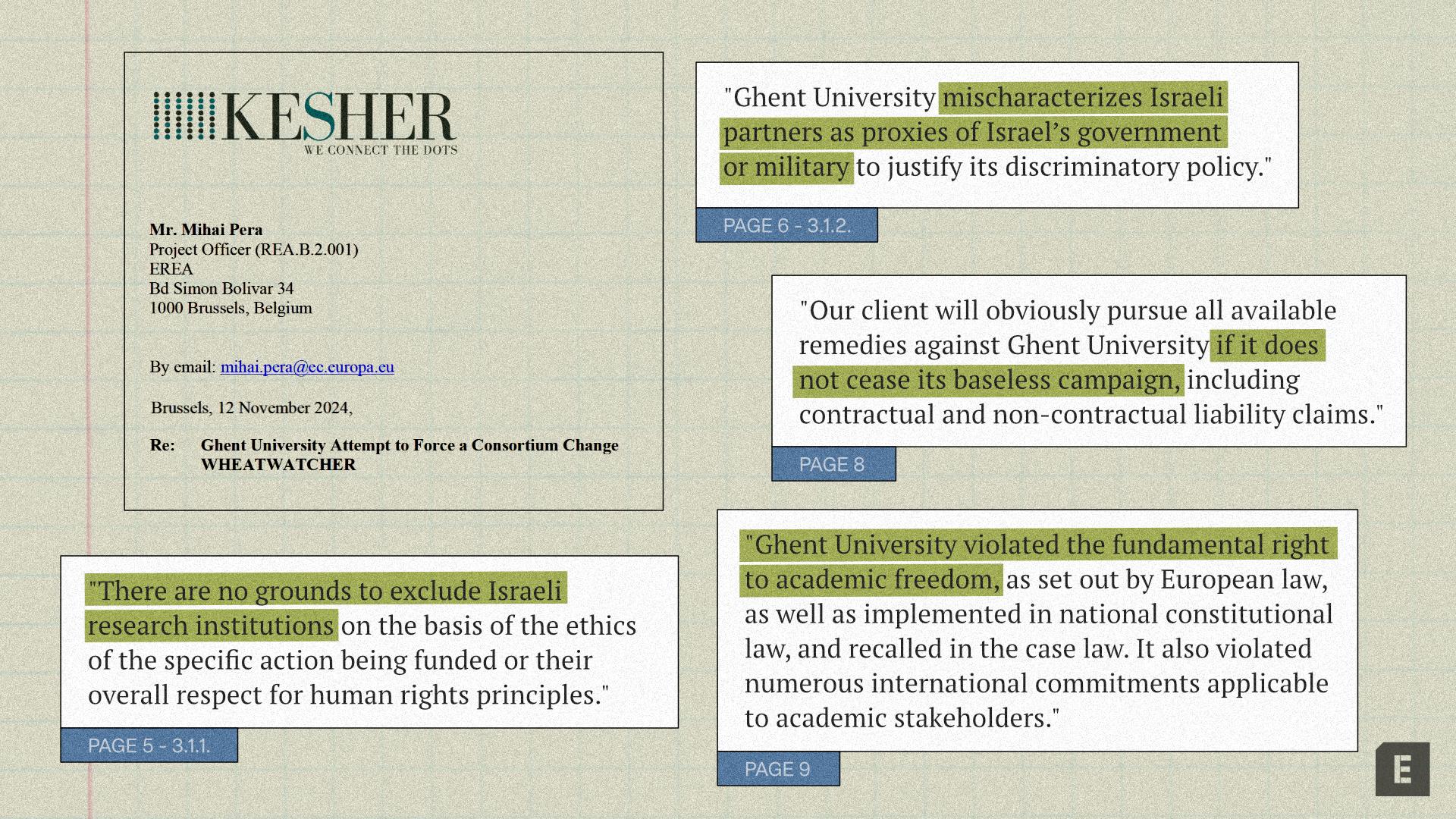
Extracts from Kesher's letter to the European Commission objecting to Ghent University's request to remove Israeli institutions from a Horizon Europe project.Credit: Spoovio
Ghent University is among dozens in Europe that announced plans to sever or suspend collaborations with Israeli academic institutions over their defence links, following widespread Israeli military attacks in Gaza since October 2023. Despite university public statements and student protests, however, many have been stymied in their efforts to do so.
A six-month investigation led by Investigate Europe and Reporters United can reveal how the law firm Kesher is part of a network working to derail universities’ exits from collaborations with Israeli partners.
At the centre is the Association of Israeli University Heads, an influential group of senior figures from Israel’s nine leading research universities. Known by its Hebrew acronym VERA, the association is composed of university presidents, rectors, and general directors who promote higher education. Since 2023, however, VERA has been at the forefront of the anti-academic boycott movement, working to counter what it sees as a “serious threat” to Israeli academia.
“Participation in the Horizon program provides not only an invaluable, irreplaceable funding boost but also enables Israel researchers to forge research partnerships… and influence Europe’s scientific and academic agenda from within,” a VERA report from May 2026 stated.
During a session in the Israeli parliament in September 2025, VERA told members present that they had spent $800,000 (€687,000) on legal work over the past two years in an effort to safeguard Israeli involvement in research initiatives.
A six-month investigation led by Investigate Europe and Reporters United can reveal how the law firm Kesher is part of a network working to derail universities’ exits from collaborations with Israeli partners.
At the centre is the Association of Israeli University Heads, an influential group of senior figures from Israel’s nine leading research universities. Known by its Hebrew acronym VERA, the association is composed of university presidents, rectors, and general directors who promote higher education. Since 2023, however, VERA has been at the forefront of the anti-academic boycott movement, working to counter what it sees as a “serious threat” to Israeli academia.
“Participation in the Horizon program provides not only an invaluable, irreplaceable funding boost but also enables Israel researchers to forge research partnerships… and influence Europe’s scientific and academic agenda from within,” a VERA report from May 2026 stated.
During a session in the Israeli parliament in September 2025, VERA told members present that they had spent $800,000 (€687,000) on legal work over the past two years in an effort to safeguard Israeli involvement in research initiatives.
“Every Horizon programme has specific focuses in the cyber world, the AI world and so on. This allows us to be part of the most advanced developments in the scientific field. If we are not there, we will simply be left behind.”
— Emmanuel Nahshon, chairman of VERA’s anti-boycott taskforce
Documents unearthed by Investigate Europe, including meeting minutes, progress reports and internal memos, detail the myriad strategies being used by VERA, Kesher and others to thwart boycotts across the continent.
Many seemingly relate to collaborations with Israeli institutions. The list details the type of action taken by the law firm in each case, from sending legal letters and working with local law firms to pressuring national authorities for support.
In an accompanying ‘interim report’ document from January 2025, Kesher outlines the “most pressing concerns” facing its work in Europe.
It describes “coordinated attacks from different universities, collaborating in groups”, citing Ghent University’s work alongside other Flemish universities. The report also claims that “universities increasingly try to preempt the discrimination argument by relying on international law obligations or targeted ‘ethical’ decisions”.
It also details possible strategies VERA could adopt to counter boycott movements, including “targeting funding to impose a disproportionate cost on boycotting bodies” and dissuade further action.
The lawyers advised VERA that together they must “develop a more robust counter-narrative to address the claim that boycotts are ‘necessary’ to comply with international obligations, or ‘morally imperative’.”
In another Google Drive folder on the VERA website found by Investigate Europe, a trove of “social media monitoring report” files reveal how the association tracks critical views and announcements across social platforms.
A legal battlefield
In a spreadsheet titled “VERA State of Affairs” found in a hyperlink buried on the VERA website, Kesher lists 27 universities across nine European countries that it has engaged over boycott ‘incidents’ on behalf of the association.Many seemingly relate to collaborations with Israeli institutions. The list details the type of action taken by the law firm in each case, from sending legal letters and working with local law firms to pressuring national authorities for support.
In an accompanying ‘interim report’ document from January 2025, Kesher outlines the “most pressing concerns” facing its work in Europe.
It describes “coordinated attacks from different universities, collaborating in groups”, citing Ghent University’s work alongside other Flemish universities. The report also claims that “universities increasingly try to preempt the discrimination argument by relying on international law obligations or targeted ‘ethical’ decisions”.
It also details possible strategies VERA could adopt to counter boycott movements, including “targeting funding to impose a disproportionate cost on boycotting bodies” and dissuade further action.
The lawyers advised VERA that together they must “develop a more robust counter-narrative to address the claim that boycotts are ‘necessary’ to comply with international obligations, or ‘morally imperative’.”
In another Google Drive folder on the VERA website found by Investigate Europe, a trove of “social media monitoring report” files reveal how the association tracks critical views and announcements across social platforms.
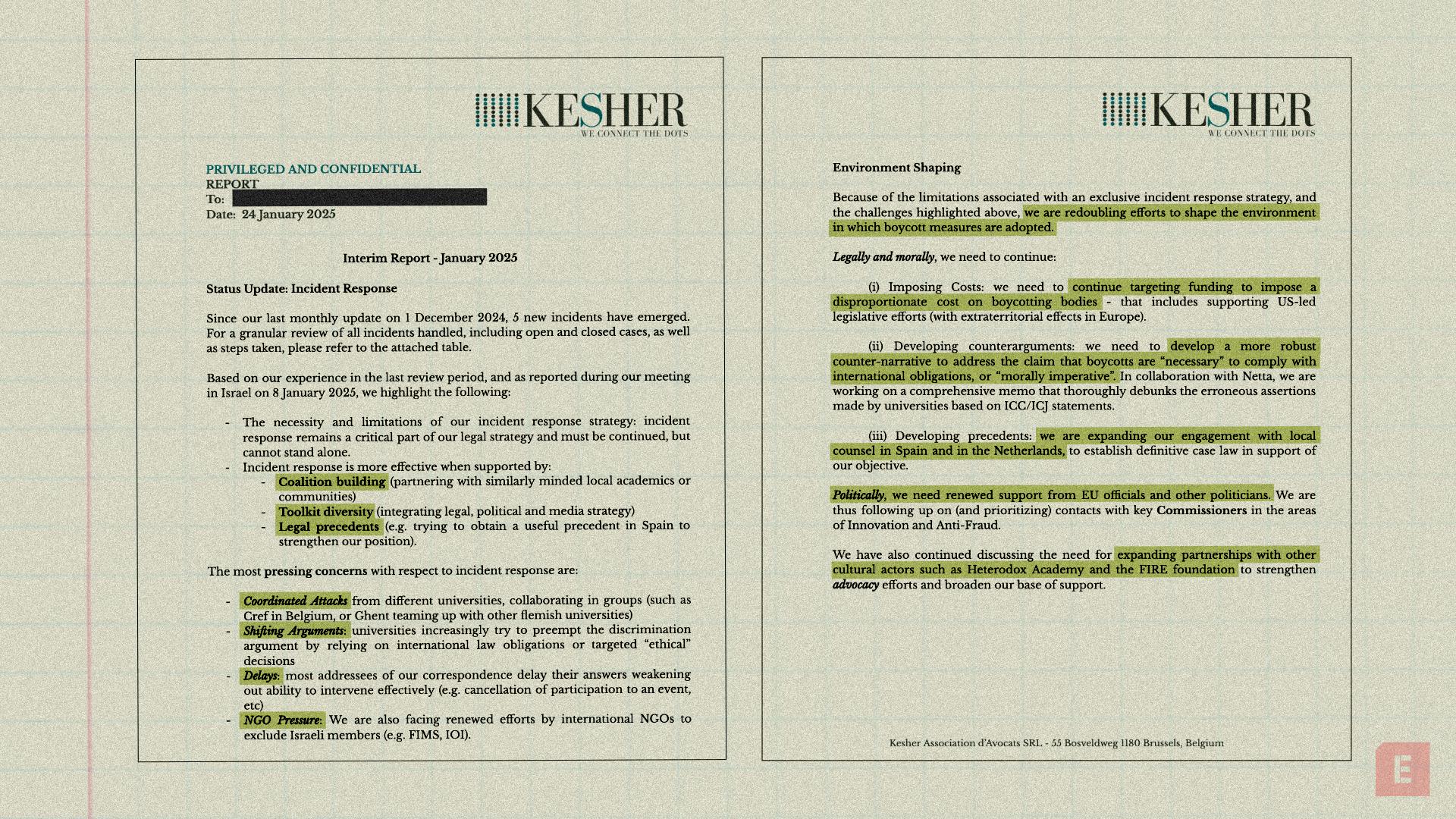
An interim report Kesher produced for VERA in January 2025 detailing its work for the association.Credit: Spoovio
Netta Barak-Corren, a VERA member and professor at the Hebrew University in Jerusalem, where the association is based, has been explicit in the need to tackle the boycott movement head-on.
“The battlefields of Israel’s eighth front extend from the halls and yards of universities to regulatory commissions and courts charged with enforcing these laws,” Barak-Corren said in 2024. “The soldiers we need to fight this battle are lawyers”.
Minutes obtained from an Israeli government meeting in January this year, meanwhile, reveal that the Council for Higher Education, the state authority responsible for academic policies, is to open a new office to "combat the academic boycott" with six million shekels (€1.7 million) in state funding for 2026.
The Council for Higher Education said it marked “a shift from reactive policy to offensive and proactive conduct” and to “building a broad and ongoing strategy; a dedicated focus on the Western European arena.”
In this context, a number of European universities sought to withdraw from research projects involving Israeli entities, particularly those linked to military programmes.
The prestigious La Sorbonne University in Paris appears to have been one such target for VERA and Kesher. A student organisation tabled a motion several times with the university’s board of trustees calling to terminate partnerships with Israeli academia, including Tel Aviv University.
In internal documents obtained by Investigate Europe, Kesher described its success in apparently derailing the initiative, citing the “close collaboration” of Israel’s ambassador to France, Joshua Zarka. Kesher said that they had received further support: “The president of the Jewish community, in collaboration with prominent French political figures (notably former ministers and the regional president), is working in close coordination and actively striving to remove this proposal from the agenda.”
According to sources inside the university’s board, the motion was ultimately successively dismissed.
The Israel Embassy in France told Investigate Europe that they “categorically deny any communication” took place between Ambassador Zarka and Kesher or VERA. A spokesperson said, however, that Israel’s embassies generally “are actively engaged in diplomatic initiatives to prevent” academic boycotts in Europe and elsewhere.
La Sorbonne said it had not communicated with Kesher or the Israel Embassy on the matter, adding that the university “has not been subject to any external influence or attempts at influence concerning the motions presented to its governing bodies.”
“The battlefields of Israel’s eighth front extend from the halls and yards of universities to regulatory commissions and courts charged with enforcing these laws,” Barak-Corren said in 2024. “The soldiers we need to fight this battle are lawyers”.
Minutes obtained from an Israeli government meeting in January this year, meanwhile, reveal that the Council for Higher Education, the state authority responsible for academic policies, is to open a new office to "combat the academic boycott" with six million shekels (€1.7 million) in state funding for 2026.
The Council for Higher Education said it marked “a shift from reactive policy to offensive and proactive conduct” and to “building a broad and ongoing strategy; a dedicated focus on the Western European arena.”
Universities under pressure
Following the International Court of Justice’s ruling in January 2024, which found it plausible that Israel's acts in Gaza could amount to violations of the Genocide Convention, and the wave of student encampments that emerged at universities around the world, concerns about ties with Israeli entities intensified. Then, in November 2024, the International Criminal Court issued arrest warrants for Prime Minister Benjamin Netanyahu and other members of his government.In this context, a number of European universities sought to withdraw from research projects involving Israeli entities, particularly those linked to military programmes.
The prestigious La Sorbonne University in Paris appears to have been one such target for VERA and Kesher. A student organisation tabled a motion several times with the university’s board of trustees calling to terminate partnerships with Israeli academia, including Tel Aviv University.
In internal documents obtained by Investigate Europe, Kesher described its success in apparently derailing the initiative, citing the “close collaboration” of Israel’s ambassador to France, Joshua Zarka. Kesher said that they had received further support: “The president of the Jewish community, in collaboration with prominent French political figures (notably former ministers and the regional president), is working in close coordination and actively striving to remove this proposal from the agenda.”
According to sources inside the university’s board, the motion was ultimately successively dismissed.
The Israel Embassy in France told Investigate Europe that they “categorically deny any communication” took place between Ambassador Zarka and Kesher or VERA. A spokesperson said, however, that Israel’s embassies generally “are actively engaged in diplomatic initiatives to prevent” academic boycotts in Europe and elsewhere.
La Sorbonne said it had not communicated with Kesher or the Israel Embassy on the matter, adding that the university “has not been subject to any external influence or attempts at influence concerning the motions presented to its governing bodies.”

A pro-Palestine demonstration outside La Sorbonne University in Paris, April 2024.Credit: Shutterstock
The University of Granada in Spain, meanwhile, has been embroiled for two years in a legal battle to defend itself against a lawsuit filed by ACOM, a pro-Israel lobbying group that challenged the university's decision to sever academic ties with Israeli institutions.
After two contradictory court rulings, the case has now reached Spain’s Supreme Court. A judgement, which is not expected until next year, is likely to set an important precedent.
ACOM has filed lawsuits against eight Spanish universities, alleging that the suspension of relations is discriminatory. The acronym stands for Action and Communication in the Middle East, and it defines itself as a “Spanish, non-denominational, and independent organization that strengthens the relationship between Spain and Israel.”
In response to the investigation, VERA spokesperson Anat Paz told Investigate Europe: “Excluding research partners or boycotting scientists based on their national origin is a direct violation of academic freedom and European anti-discrimination norms. VERA engages legal counsel solely to protect Israeli researchers from such unlawful discrimination and to ensure that scientific partnerships are not derailed by politicised campaigns.”
They added that Israeli participation in Horizon projects is “grounded in scientific excellence” and that its universities are governed by “comprehensive civil and ethical compliance mechanisms overseen by the European Commission.”
Kesher, ACOM and the Council for Higher Education did not respond to requests for comment. The University of Granada also did not reply by the time of publication.
After two contradictory court rulings, the case has now reached Spain’s Supreme Court. A judgement, which is not expected until next year, is likely to set an important precedent.
ACOM has filed lawsuits against eight Spanish universities, alleging that the suspension of relations is discriminatory. The acronym stands for Action and Communication in the Middle East, and it defines itself as a “Spanish, non-denominational, and independent organization that strengthens the relationship between Spain and Israel.”
In response to the investigation, VERA spokesperson Anat Paz told Investigate Europe: “Excluding research partners or boycotting scientists based on their national origin is a direct violation of academic freedom and European anti-discrimination norms. VERA engages legal counsel solely to protect Israeli researchers from such unlawful discrimination and to ensure that scientific partnerships are not derailed by politicised campaigns.”
They added that Israeli participation in Horizon projects is “grounded in scientific excellence” and that its universities are governed by “comprehensive civil and ethical compliance mechanisms overseen by the European Commission.”
Kesher, ACOM and the Council for Higher Education did not respond to requests for comment. The University of Granada also did not reply by the time of publication.
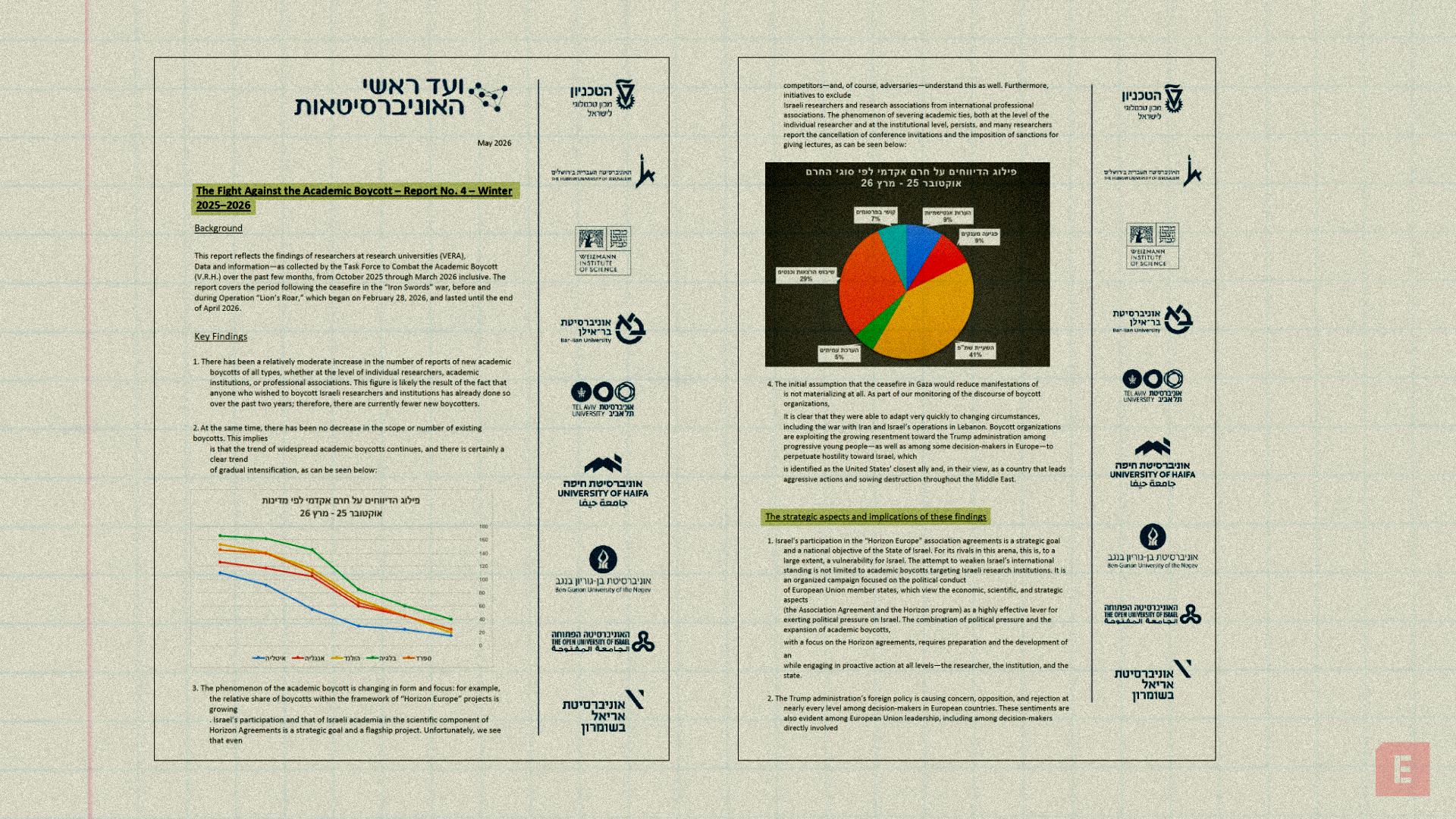
A VERA report published in May 2026 laying out its work against academic boycotts in Europe.Credit: Spoovio
European Commission stance
The European Commission has consistently defended entities from Israel, which in 2021 signed a special agreement regarding Horizon Europe, placing it on an equal footing with participating EU countries.An Israeli institution has yet to be suspended from a project for breaching the ethical values set out in Article 14 of the Horizon Europe Grant Agreement. This states that “the action must be carried out in line with the highest ethical standards and the applicable EU, international and national law on ethical principles.”
A letter sent in July 2024 by the then Commissioner for Research Iliana Ivanova to VERA made the position clear: “Termination solely on the basis of nationality would be improper and would amount to discrimination prohibited under the Association Agreement.”
The Bulgarian Commissioner went on to reassure VERA members: “Please rest assured that academic freedom, as set out in the Charter of Fundamental Rights of the European Union, is one of the fundamental rights that apply to the EU institutions and to Member States when they apply EU law.”
The same principle was reiterated in late 2025, when the new Commissioner for Research, Ekaterina Zaharieva, said that “any actions or behaviour of the State of Israel cannot be considered automatically attributable to Israeli entities participating in Horizon Europe.”
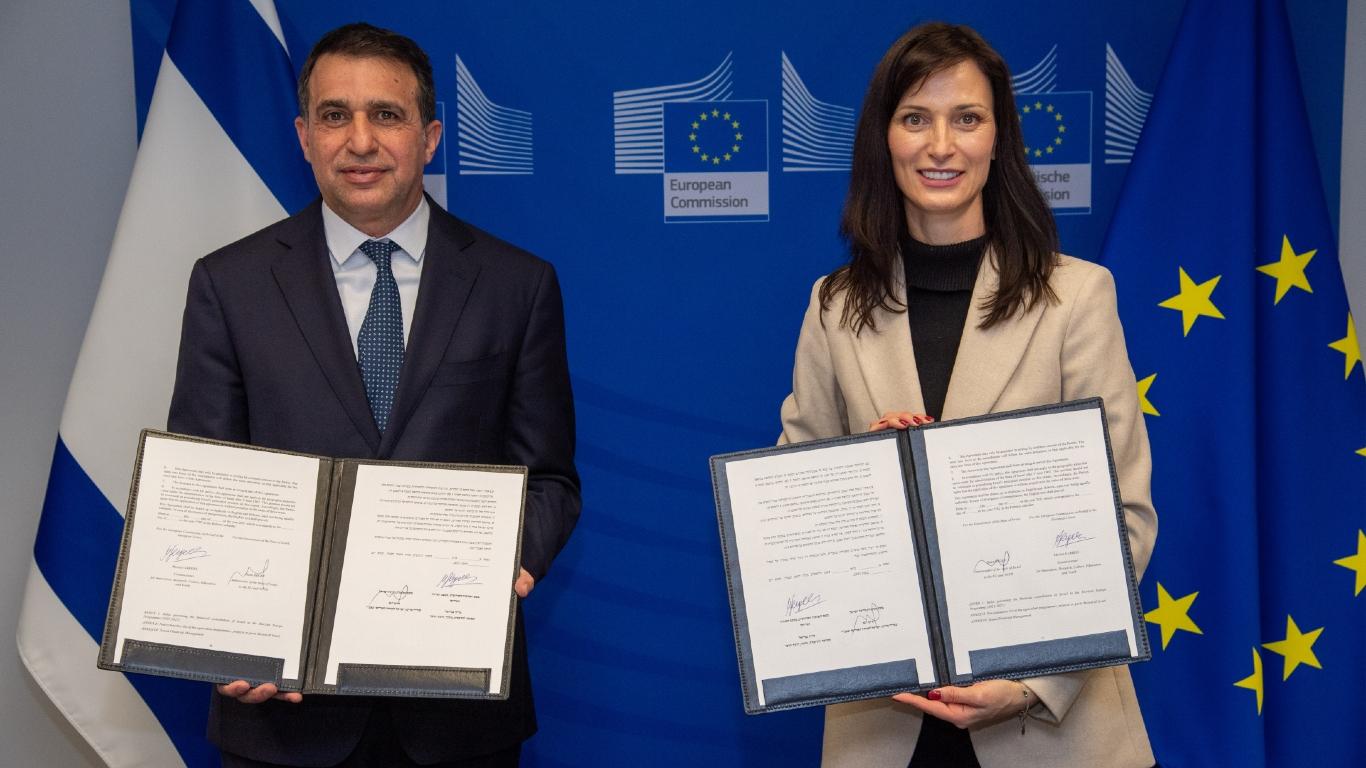
Israel and the European Commission signed an agreement associating Israel to Horizon Europe in 2021.Credit: European Union
It is widely stated by officials that in order to suspend projects with Israeli entities, the EU-Israel Association Agreement must first be suspended, which requires unanimity among Member States or even just a qualified majority in the case of trade agreements.
“But this has nothing to do with compliance with the ethical values set out in Article 14 of the Horizon Europe Model Grant Agreement, which concerns every beneficiary, even among EU countries,” said Professor Yiorgos Vassalos, a researcher at the Free University of Brussels.
On 4 March 2022, less than 10 days after the first Russian attacks on Kyiv, the Commission announced that it had suspended all payments for 29 ongoing Russian research projects, totalling €12.6 million. Then on 8 April 2022, the Commission formalised the decision together with the approval of a fifth package of sanctions against Russia.
“The Commission is trying to find legalistic excuses, whereas the issue at hand is very simple,” Vassalos said. “There is so much evidence of human rights violations in Israel, more than we can find in any other conflict.”
In July 2025, the Commission proposed suspending Israel’s participation in certain Horizon schemes linked to the European Innovation Council, a measure that has remained blocked in the Council ever since for lack of a majority among member states.
A recent investigation from EUobserver, meanwhile, found that the Commission’s legal service advised the Commission back in 2017 that it was entitled to suspend cooperation with Israel, such as its Horizon Europe science grants and Erasmus student-exchange scheme without waiting for a formal vote.
A Commission spokesperson rejected any comparison between Israeli and Russian involvement in Horizon Europe projects, adding that any requests to terminate Israeli participation in projects are assessed on a case-by-case basis.
“But this has nothing to do with compliance with the ethical values set out in Article 14 of the Horizon Europe Model Grant Agreement, which concerns every beneficiary, even among EU countries,” said Professor Yiorgos Vassalos, a researcher at the Free University of Brussels.
On 4 March 2022, less than 10 days after the first Russian attacks on Kyiv, the Commission announced that it had suspended all payments for 29 ongoing Russian research projects, totalling €12.6 million. Then on 8 April 2022, the Commission formalised the decision together with the approval of a fifth package of sanctions against Russia.
“The Commission is trying to find legalistic excuses, whereas the issue at hand is very simple,” Vassalos said. “There is so much evidence of human rights violations in Israel, more than we can find in any other conflict.”
In July 2025, the Commission proposed suspending Israel’s participation in certain Horizon schemes linked to the European Innovation Council, a measure that has remained blocked in the Council ever since for lack of a majority among member states.
A recent investigation from EUobserver, meanwhile, found that the Commission’s legal service advised the Commission back in 2017 that it was entitled to suspend cooperation with Israel, such as its Horizon Europe science grants and Erasmus student-exchange scheme without waiting for a formal vote.
A Commission spokesperson rejected any comparison between Israeli and Russian involvement in Horizon Europe projects, adding that any requests to terminate Israeli participation in projects are assessed on a case-by-case basis.
“It cannot be ruled out that results from a given project, although initially intended and funded solely for civil applications, could later be further developed into technologies with dual-use applications.”
— European Commission spokesperson
Horizon Europe 2028–34
Negotiations are currently underway in Brussels on the rules for the next Horizon Europe programme for the period 2028–34.Some MEPs want a clearer framework included so universities are able to withdraw from a project. There are also efforts being made to limit the role of countries in dual-use or defence projects.
“Our aim is to bring Article 14 on ethical principles to the forefront, as a condition for participating in a project, so a state, in this case Israel, but it could soon be another associated country, would be excluded from the start,” Lina Galvez, Rapporteur for the Socialists & Democrats group in the European Parliament, told Investigate Europe.
Meanwhile, Israel’s anti-academic boycott movement is closely monitoring negotiations.
“The real danger is the next Horizon,” VERA’s Emmanuel Nahshon said back in September last year, “which, as things stand, if the discussion were to take place today, it is by no means certain that Israel would be accepted into the new Horizon."
Editor: Chris Matthews
Fact-checking: Ella Joyner
This investigation is led by Investigate Europe, a cross-border team of investigative journalists and Reporters United, an investigative newsroom in Athens, Greece. The story is being published with media partners including EUobserver, Follow the Money, Il Fatto Quotidiano, Knack, Le Monde, Le Vif, and Publico.es.