


.jpg&w=1920&q=75)
Revealed: European universities struggle to cut out Israeli research partners
.jpg&w=3840&q=75)
Credit: Spoovio


Dozens of universities pledged to stop or suspend ties with Israeli institutions over the war in Gaza, a new Investigate Europe and Reporters United investigation, however, reveals that many are now engaged in new Horizon Europe research projects.
At the start of the academic year last September, the rector of the University of Granada sent a message to students and faculty members. Professor Pedro Mercado Pacheco stressed that the university must continue to be “a space for dialogue, critical reflection… the defence of human rights and the building of peace.” While attacks on Gaza raged, the university was engaged in its own battle in the courts after deciding to suspend collaboration with Israeli entities involved in multi-million European Union research projects.
The high-profile case has now reached Spain’s Supreme Court, following a lengthy fight with ACOM (Action and Communication in the Middle East), a pro-Israel advocacy group, attempting to block the decision. A verdict is not expected until next year. The outcome could set a precedent on whether Spanish universities can use the defence of international law in such instances.
Yet the legal action is at odds with a recent move by the university to stand by another project. Shortly before Granada pledged to suspend collaborations last year, it signed up to a new research project called PROACTIF involving Israeli microchip company Mellanox, as well as European defence giants Safran and Leonardo.
The project, part of the EU’s flagship Horizon Europe research programme, will develop unmanned vehicles in a system that will “deploy aerial, ground, and surface robots to respond to incidents.”
The technologies involved, however, have dual-use potential, meaning for both civilian and military purposes. Mellanox’s technology has been used by defence and government clients, including Israeli Aerospace Industries, whose Heron drones have reportedly been used by the Israeli army in Gaza and the US Department of Defense.
Granada has defended itself by stating that Mellanox is now owned by the US company Nvidia, and therefore is no longer considered an Israeli company. However, the Horizon Europe database still lists the company as Israeli, which has enabled it to receive funding because of Israel’s association agreement with the EU.
Similar scenarios are playing out at universities across Europe. Despite announcing to cut ties with Israeli research partners following the International Court of Justice’s ruling in January 2024, which warned of a risk of genocide in Gaza, many universities have gone on to sign new Horizon projects.
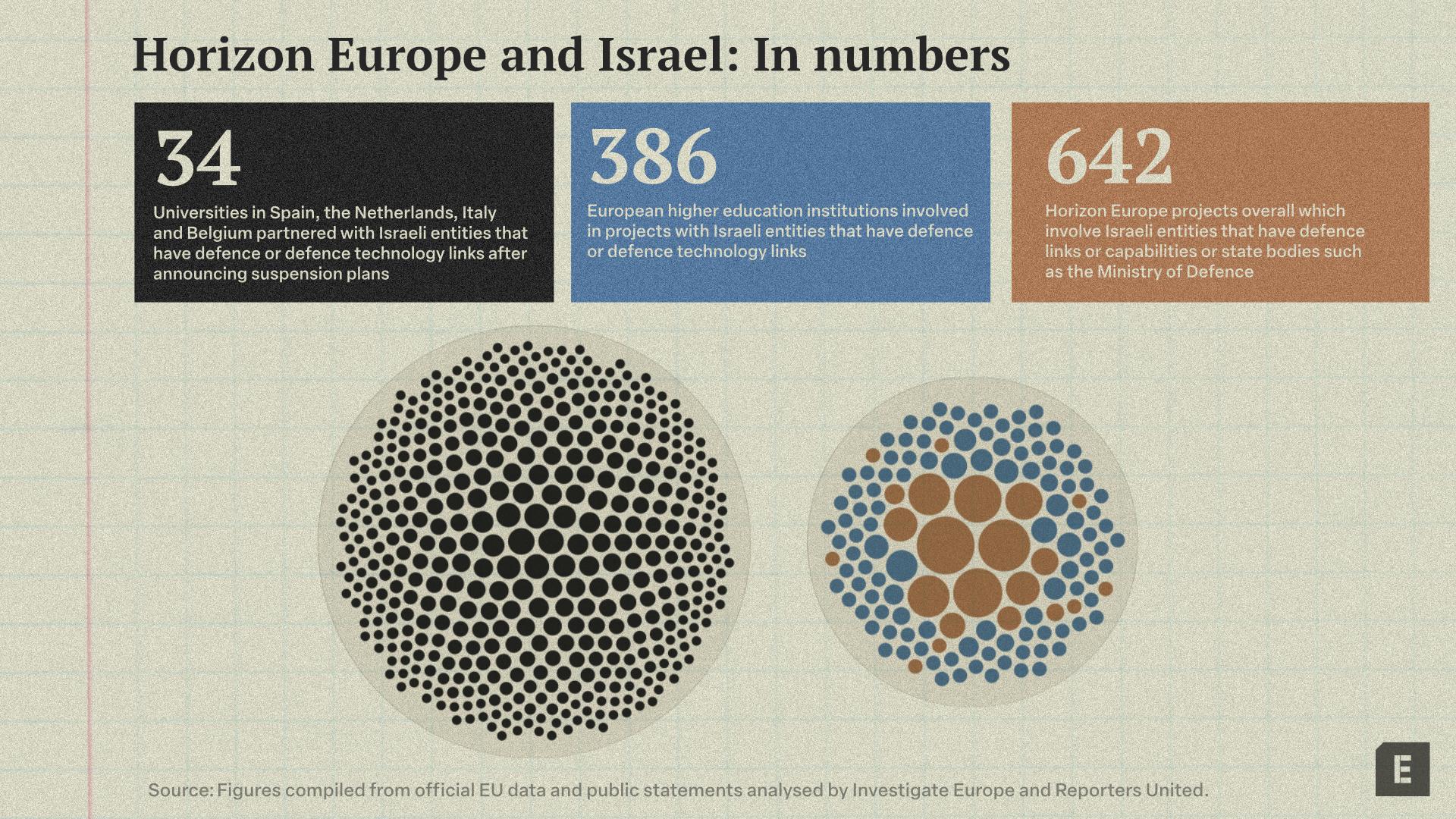
Exclusive analysis of the EU CORDIS database alongside freedom of information requests by Investigate Europe and Reporters United can reveal that 34 European universities are involved in 38 new Horizon projects with Israeli entities that have defence links or capabilities, after announcing their suspension policies. The universities, based in Spain, the Netherlands, Italy and Belgium, received €15 million in funding for the projects.
Six projects appear to involve technologies with dual-use potential and involve Israeli partners such as Holon Institute of Technology, Weebit Nano, Mellanox and Technion Institute. The analysis also found that six universities in Spain, Italy and Belgium, which have successfully withdrawn from Horizon projects due to such links, are still engaged in other projects.
The collaborations highlight a tension between universities publicly condemning Israeli entities with defence or state links while privately maintaining partnerships.
Across Horizon Europe, 386 European higher education institutions are currently involved in 205 projects with Israeli entities that have defence or defence technology links, the analysis found. In addition, 12 projects involve Israeli state or public bodies, with 128 European institutions participating.
The high-profile case has now reached Spain’s Supreme Court, following a lengthy fight with ACOM (Action and Communication in the Middle East), a pro-Israel advocacy group, attempting to block the decision. A verdict is not expected until next year. The outcome could set a precedent on whether Spanish universities can use the defence of international law in such instances.
Yet the legal action is at odds with a recent move by the university to stand by another project. Shortly before Granada pledged to suspend collaborations last year, it signed up to a new research project called PROACTIF involving Israeli microchip company Mellanox, as well as European defence giants Safran and Leonardo.
The project, part of the EU’s flagship Horizon Europe research programme, will develop unmanned vehicles in a system that will “deploy aerial, ground, and surface robots to respond to incidents.”
The technologies involved, however, have dual-use potential, meaning for both civilian and military purposes. Mellanox’s technology has been used by defence and government clients, including Israeli Aerospace Industries, whose Heron drones have reportedly been used by the Israeli army in Gaza and the US Department of Defense.
Granada has defended itself by stating that Mellanox is now owned by the US company Nvidia, and therefore is no longer considered an Israeli company. However, the Horizon Europe database still lists the company as Israeli, which has enabled it to receive funding because of Israel’s association agreement with the EU.
Similar scenarios are playing out at universities across Europe. Despite announcing to cut ties with Israeli research partners following the International Court of Justice’s ruling in January 2024, which warned of a risk of genocide in Gaza, many universities have gone on to sign new Horizon projects.
Exclusive analysis of the EU CORDIS database alongside freedom of information requests by Investigate Europe and Reporters United can reveal that 34 European universities are involved in 38 new Horizon projects with Israeli entities that have defence links or capabilities, after announcing their suspension policies. The universities, based in Spain, the Netherlands, Italy and Belgium, received €15 million in funding for the projects.
Six projects appear to involve technologies with dual-use potential and involve Israeli partners such as Holon Institute of Technology, Weebit Nano, Mellanox and Technion Institute. The analysis also found that six universities in Spain, Italy and Belgium, which have successfully withdrawn from Horizon projects due to such links, are still engaged in other projects.
The collaborations highlight a tension between universities publicly condemning Israeli entities with defence or state links while privately maintaining partnerships.
Across Horizon Europe, 386 European higher education institutions are currently involved in 205 projects with Israeli entities that have defence or defence technology links, the analysis found. In addition, 12 projects involve Israeli state or public bodies, with 128 European institutions participating.
Credit: Spoovio
Technion ties to Israeli defence
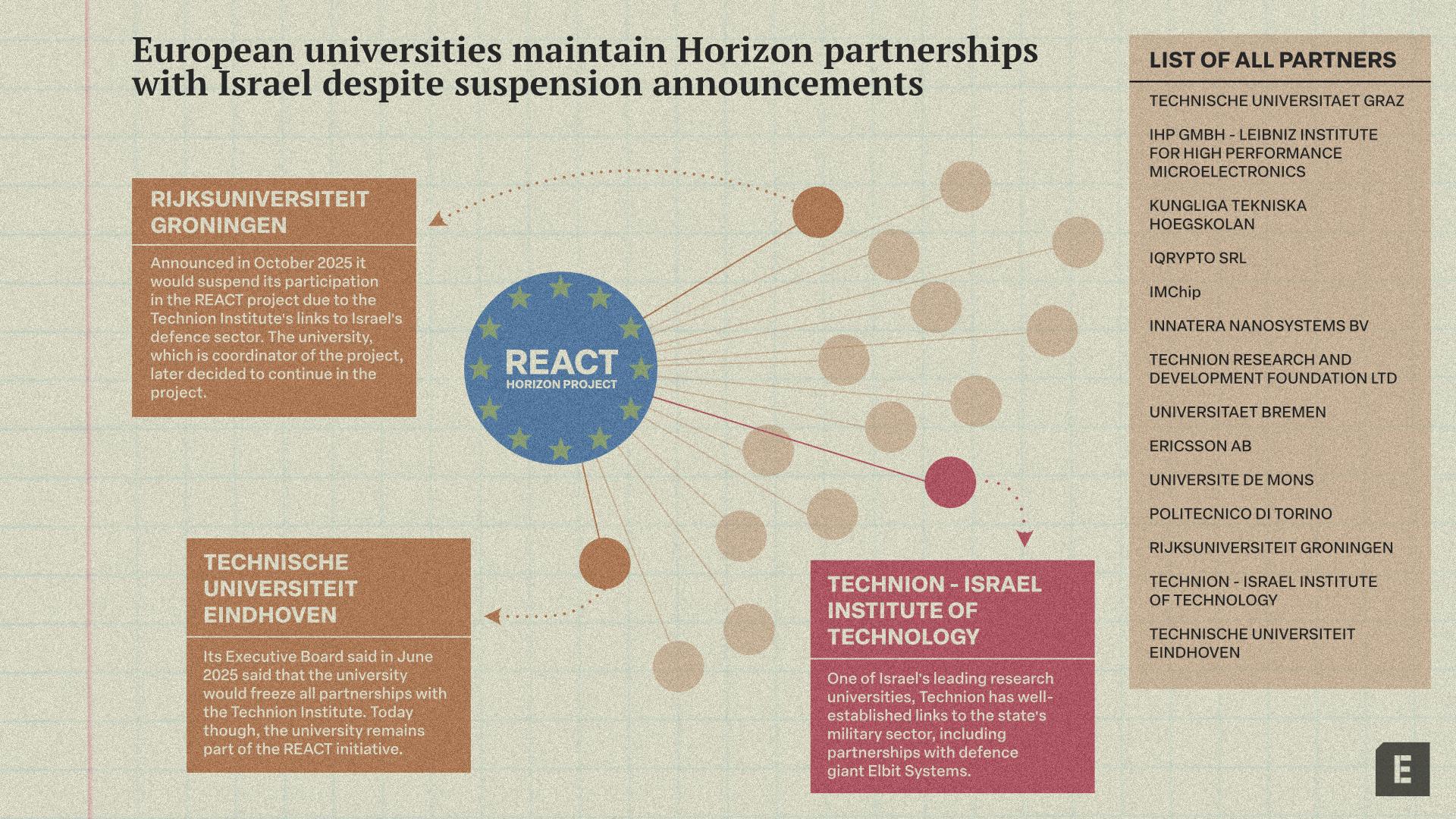
In the Netherlands, at least two universities have so far failed to extricate themselves from projects tied to Israeli entities, despite public statements to the contrary.Following revelations that a professor at the Technion Institute of Technology was serving as a reserve lieutenant colonel in the Israeli army, the University of Groningen announced in October 2025 it would suspend its participation in the REACT project, involving the institute.
Professor Shahar Kvatinsky, a faculty chair and dean in Technion’s Electrical and Computer Engineering department, served several times in Gaza and Lebanon since 7 October 2023, according to the De Trouw investigation. On his Facebook profile, he posted photos in 2023 and 2024 showing him standing in army uniform in front of destroyed apartment blocks, and sitting at a table in a war room with Israeli Prime Minister Benjamin Netanyahu.
However, two weeks after the suspension announcement, Groningen said it would instead limit its participation to direct collaboration with researchers at Technion. Eindhoven University of Technology, another partner, said it would continue with the project, despite previously announcing it would freeze partnerships with Technion.
Technion has close ties to Israel’s military sector, developing technologies for defence firms Elbit Systems, one of the institute’s highest-level supporters, and Israel Aerospace Industries, producing the D9 remote controlled bulldozers used by the Israel Defense Forces (IDF), and running a data science programme for soldiers.
Technion also operates the Advanced Defense Research Institute, created to connect academic research with the IDF, security bodies and wider defence industry. Its head, Jacob Nagel, who chaired Netanyahu’s 2024 security strategy committee, has said Technion research is critical to next-generation drones and hypersonic missiles. During the Gaza war he said that researchers “rapidly turned academic concepts into operational solutions for the battlefield,” including drone swarms, cyber defence and battlefield robotics.
Credit: Spoovio
According to Investigate Europe and Reporters United’s analysis, Technion maintains a strong presence in Dutch universities: it appears in ongoing or newly started collaborations involving TU Delft, Eindhoven University of Technology, and the universities of Radboud, Tilburg, Amsterdam, and Groningen.
Groningen told Investigate Europe that it is awaiting advice from its advisory group about its involvement in the REACT project.
A spokesperson said: “Should we receive a new application for a Horizon Europe project involving Israeli entities connected to its military-industrial complex, then this will first be submitted to the Advisory Team Knowledge Security and Sensitive Partnerships. Their advice will then be presented to the Executive Board, which will make a decision.”
Eindhoven University of Technology said it is setting up a committee to evaluate sensitive collaborations and “priority will be given to an assessment of our Institutional relation with Technion", a spokesperson added.
The Technion Institute and Professor Kvatinsky did not respond to requests for comment.
Groningen told Investigate Europe that it is awaiting advice from its advisory group about its involvement in the REACT project.
A spokesperson said: “Should we receive a new application for a Horizon Europe project involving Israeli entities connected to its military-industrial complex, then this will first be submitted to the Advisory Team Knowledge Security and Sensitive Partnerships. Their advice will then be presented to the Executive Board, which will make a decision.”
Eindhoven University of Technology said it is setting up a committee to evaluate sensitive collaborations and “priority will be given to an assessment of our Institutional relation with Technion", a spokesperson added.
The Technion Institute and Professor Kvatinsky did not respond to requests for comment.

A number of Israeli academic institutions have established ties with its defence sector.Credit: Shutterstock
Dual-use potential
Around other universities in Europe, partnerships with Israeli entities developing technology that has possible dual-use capabilities remain in place. At the University of Bologna in Italy, its supervisory board said last autumn that it would not sign off on new research projects with dual-use potential involving Israeli entities, and would suspend existing ones.Yet according to documents obtained from freedom of information requests, in December 2025 the university rolled back on its position after conducting a legal analysis of the potential costs and its contractual obligations. Bologna remains part of Horizon’s NeAIxt, another project developing technologies that could have dual-use potential.
Among the NeAIxt partners is Weebit Nano, an Israeli semiconductor company developing advanced technology that can be used for aerospace and defence. Weebit was until recently a member of the NEMO Consortium, alongside Elbit Systems and the Technion Institute.
When approached for comment, the company said: “Weebit has never worked with any defense company/military body, whether Israeli or foreign.” They said its role in the NEMO consortium ended at the start of 2026 and “at no point did Weebit transfer, license or disclose its IP, proprietary technology or know-how to Elbit Systems” or other members.
The University of Bologna said that as a public entity it “cannot act in conflict with the existing obligations assumed by the Italian Republic at the international and supranational levels” which could have been breached if it withdrew from the project.
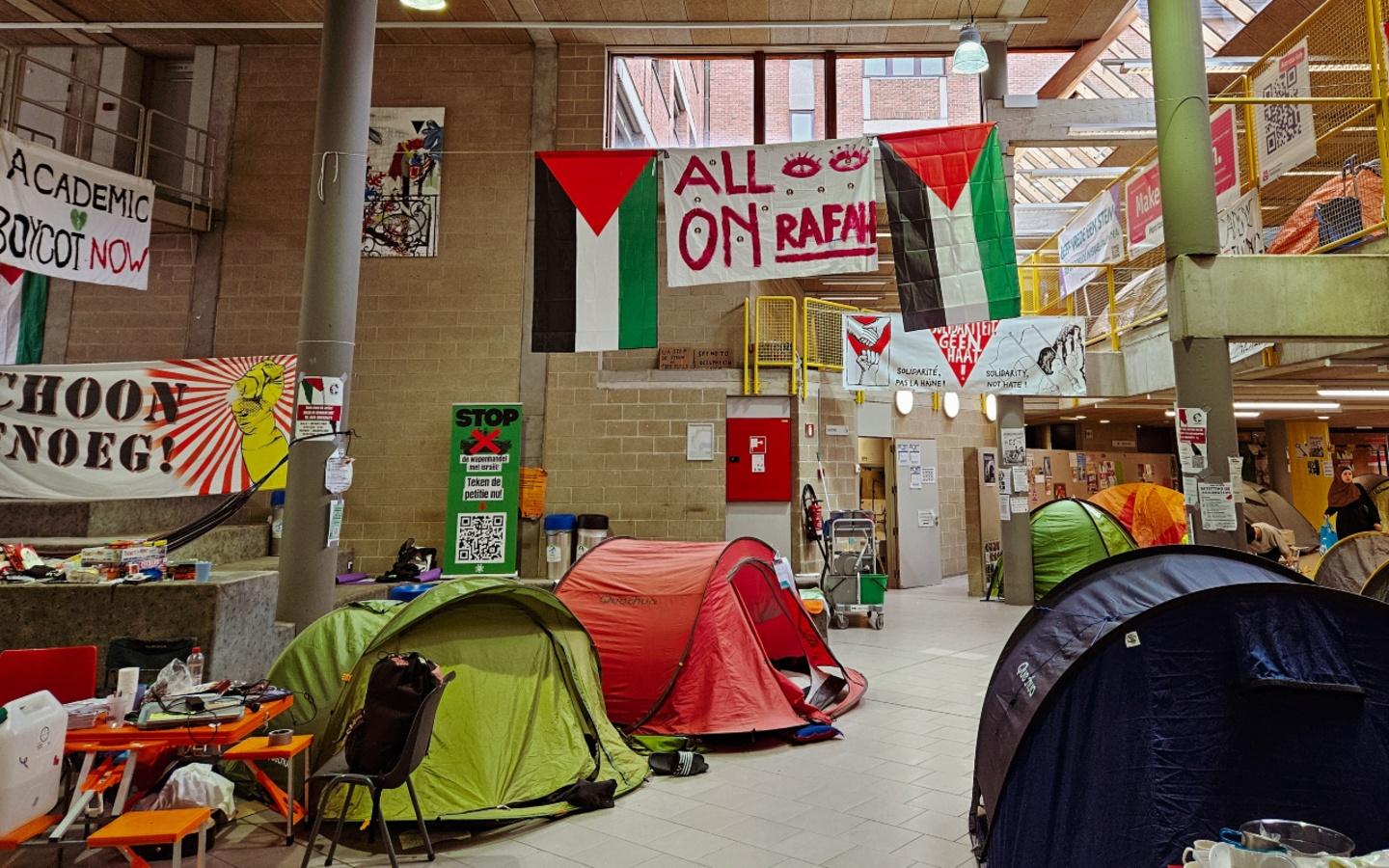
A student encampment for Palestine and the academic boycott at a university in Belgium, May 2024.Credit: Shutterstock
Paris-Saclay University is currently involved in six Horizon Europe projects involving Israeli entities with defence links. Five of the projects started after October 7 2023.
Among them is STARLight, a project developing silicon photonics technology, involving Mellanox (now owned by Nvidia). The technology is known to be used in both civilian and defence arenas. Lidar scanners already incorporate this technology for high-precision environmental assessment and targeting, reportedly used by the IDF in Gaza. The Horizon project’s partners also include French defence company Thales.
Paris-Saclay’s Council for Research Ethics and Scientific Integrity recommended in February 2026 “suspending, pending review, partnerships with Israeli universities”, notably Tel Aviv University.
Yet soon after publication, the President’s office decided to withdraw the statement, citing the Ministry of Higher Education’s opinion that “a political stance, based on considerations such as the conflict in the Middle East, cannot justify higher education institutions, on their own initiative, calling into question their partnerships with foreign universities.”
Paris-Saclay told Investigate Europe that “its research teams take part in European projects without enquiring about the nationality of their partners” and that they “are free to work and publish with whomever they wish worldwide”.
Mellanox did not respond to requests for comment by the time of publication.
The University of Granada, which is partnered with Mellanox in PROACTIF, also did not respond. Francisco Barranco, the professor leading the project for the university, however, told Investigate Europe that they were “already formally committed” to the proposal before the academic boycott began. He added that the project is strictly civilian, even though this kind of technology can produce results with potential dual-use applications.
Among them is STARLight, a project developing silicon photonics technology, involving Mellanox (now owned by Nvidia). The technology is known to be used in both civilian and defence arenas. Lidar scanners already incorporate this technology for high-precision environmental assessment and targeting, reportedly used by the IDF in Gaza. The Horizon project’s partners also include French defence company Thales.
Paris-Saclay’s Council for Research Ethics and Scientific Integrity recommended in February 2026 “suspending, pending review, partnerships with Israeli universities”, notably Tel Aviv University.
Yet soon after publication, the President’s office decided to withdraw the statement, citing the Ministry of Higher Education’s opinion that “a political stance, based on considerations such as the conflict in the Middle East, cannot justify higher education institutions, on their own initiative, calling into question their partnerships with foreign universities.”
Paris-Saclay told Investigate Europe that “its research teams take part in European projects without enquiring about the nationality of their partners” and that they “are free to work and publish with whomever they wish worldwide”.
Mellanox did not respond to requests for comment by the time of publication.
The University of Granada, which is partnered with Mellanox in PROACTIF, also did not respond. Francisco Barranco, the professor leading the project for the university, however, told Investigate Europe that they were “already formally committed” to the proposal before the academic boycott began. He added that the project is strictly civilian, even though this kind of technology can produce results with potential dual-use applications.
Credit: Spoovio
Financial fears
The reasons why universities would remain linked to Israeli entities despite widespread protests and public condemnation are varied, but demonstrate the economic reality many universities must now balance alongside ethical considerations.Faced with shrinking funding streams and a steep decline in enrolment, the budgets of European universities are increasingly being stretched thin, academics explain. As university finance departments forecast a bleak economic future, the risk of withdrawal comes with added considerations for institutions.
“The problem is that over the years, consortia have emerged that systematically access the same funding, and getting in is extremely difficult unless you are introduced by someone already in the consortium,” said Dr. Gaetano Salina, a physicist at Italy’s National Institute of Nuclear Physics, which is affiliated with the Tor Vergata University in Rome.
“Closed communities have formed around European projects: the same entities, the same universities, the same funding streams that remain constant over time. In many cases, the projects are essentially pies to be divided up.”
— Dr. Gaetano Salina
The fear of being excluded from future projects weighs heavily on European research in the midst of historical academic budget shortfalls.
Maria José Lera, an associate professor at the University of Seville and member of the University Network for Palestine, a group of professors from Spain’s public universities, said: “In the end Israel has the money, the project goes ahead, and we are the ones who lose out. Moreover, they may now see us as unreliable partners and may not call on us in the future.”
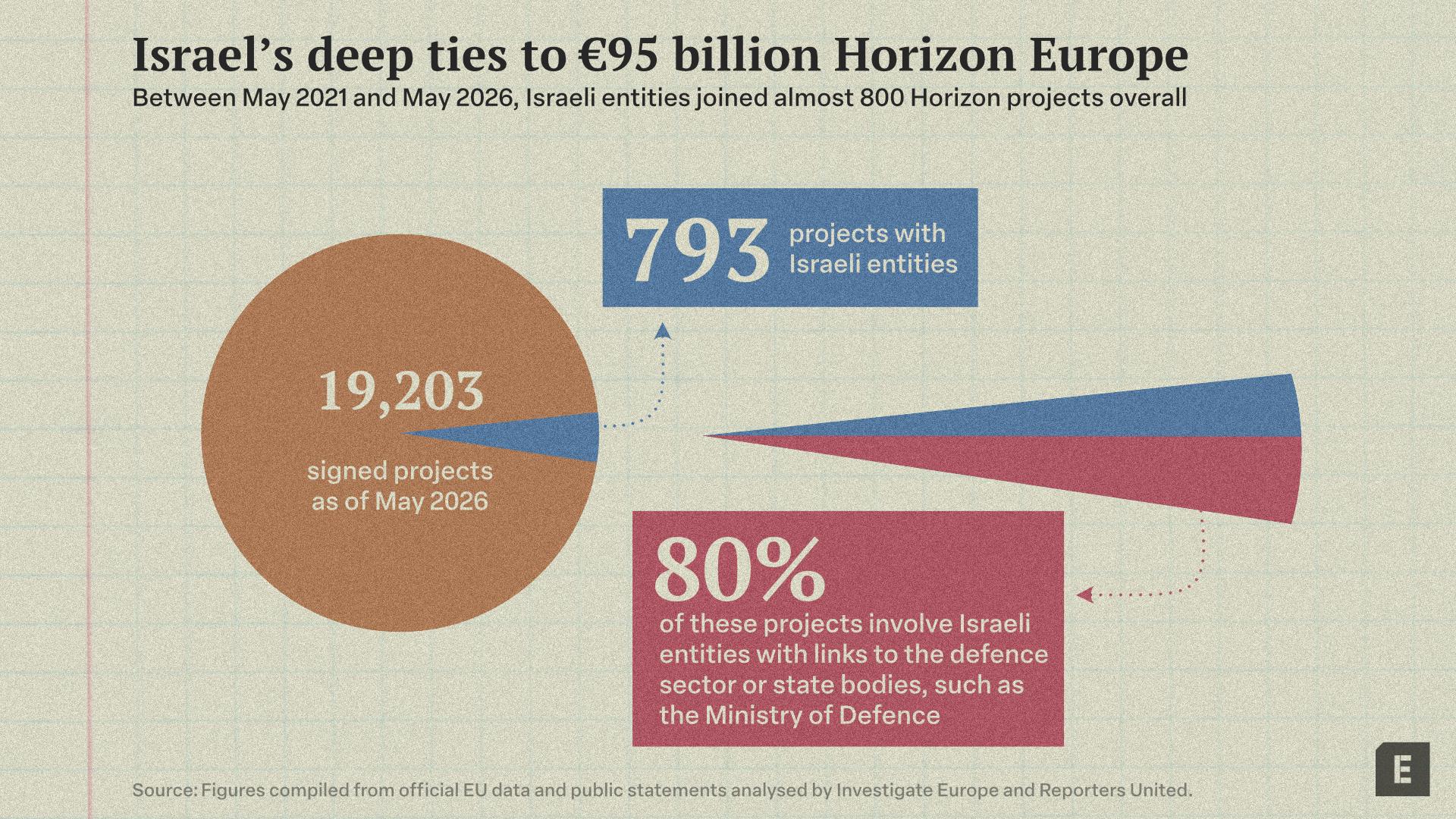
Horizon partnerships with Israel run deep within institutions across Europe. In total, Israeli entities were participating in 793 of Horizon Europe’s 19,203 signed Horizon projects as of May 2026, accounting for around one in every 24 projects. This figure covers all projects with at least one Israeli entity, not only those involving European universities.
The analysis found that 80 per cent involve Israeli entities with links to the defence sector or state bodies such as the Ministry of Defence.
The University of Delft, one of Europe’s largest technology campuses, is involved in a collaboration with Airbus and other major defence companies. In December 2025, the Dutch university confirmed it had withdrawn from NeAIxt – the Horizon project involving Israeli firm Weebit Nano.
“We ended our participation in December 2025, with the knowledge and consent of the consortium partners, following an assessment under the decision of our Executive Board of 10 June 2025,” a University of Delft spokesperson told Investigate Europe.
In earlier email exchanges between the university’s administrators debating the move, obtained via freedom of information requests, the legal fears around withdrawing were made clear.
Maria José Lera, an associate professor at the University of Seville and member of the University Network for Palestine, a group of professors from Spain’s public universities, said: “In the end Israel has the money, the project goes ahead, and we are the ones who lose out. Moreover, they may now see us as unreliable partners and may not call on us in the future.”
Horizon partnerships with Israel run deep within institutions across Europe. In total, Israeli entities were participating in 793 of Horizon Europe’s 19,203 signed Horizon projects as of May 2026, accounting for around one in every 24 projects. This figure covers all projects with at least one Israeli entity, not only those involving European universities.
The analysis found that 80 per cent involve Israeli entities with links to the defence sector or state bodies such as the Ministry of Defence.
Legal risks
Some universities say they fear not only reputational but legal ramifications for leaving projects.The University of Delft, one of Europe’s largest technology campuses, is involved in a collaboration with Airbus and other major defence companies. In December 2025, the Dutch university confirmed it had withdrawn from NeAIxt – the Horizon project involving Israeli firm Weebit Nano.
“We ended our participation in December 2025, with the knowledge and consent of the consortium partners, following an assessment under the decision of our Executive Board of 10 June 2025,” a University of Delft spokesperson told Investigate Europe.
In earlier email exchanges between the university’s administrators debating the move, obtained via freedom of information requests, the legal fears around withdrawing were made clear.
“If we do not keep these promises, this can have not only serious legal and financial consequences, but also affect the possibilities of obtaining future subsidies. Withdrawal entails reputational risks not only for Delft (not being a reliable partner for new projects), but also for individual researchers.”
— A Delft University administrator in an email exchange
The University of Ghent in Belgium estimated that the costs of unilateral withdrawal from Horizon projects “could run into tens of millions of euros”, a spokesperson told Investigate Europe.
In March 2026, however, Ghent became one of only a handful of universities to successfully exit a project because of the involvement of an Israeli partner. It was achieved only after they found a replacement partner and approval from the majority of those in the consortium, according to sources close to the process.
A Ghent spokesperson said that the university “remains fully committed to implementing its policy on institutional Israeli collaborations without exception”, and withdrawal procedures had started for five other Horizon projects involving Israeli partners.
Yet student activists at the university remain frustrated with what they see as a clear path to refuse collaboration with Israeli institutions linked to the war in Gaza.
“There are still ongoing ties with Israeli entities through Horizon Europe projects,” Jarkko, a student involved in the protests, told Investigate Europe before the recent summer recess. “The legislative texts provide a legal basis to suspend or withdraw if ethical principles are not respected. Why are we still waiting?”
A spokesperson for the Association of Israeli University Heads (VERA), which represents its nine leading research universities, said: “Our participation in Horizon Europe is grounded in scientific excellence and strictly governed by the comprehensive civil and ethical compliance mechanisms overseen by the European Commission.
“Excluding research partners or boycotting scientists based on their national origin is a direct violation of academic freedom and European anti-discrimination norms.”
A European Commission spokesperson told Investigate Europe that any requests to terminate Israeli participation in Horizon projects are assessed on a case-by-case basis. “When implementing projects, all beneficiaries must ensure that all activities comply with... ethical principles and relevant national, Union and international law,” they added. “Notwithstanding the above… it cannot be excluded that the results could be further developed into technologies with dual-use application”.
------
Editors: Mei-Ling McNamara, Chris Matthews
Fact-checking: Ella Joyner
This investigation is led by Investigate Europe, a cross-border team of investigative journalists and Reporters United, an investigative newsroom in Athens, Greece. The story is being published with media partners including EUobserver, Follow the Money, Il Fatto Quotidiano, Knack, Le Monde, Le Vif, and Publico.es.
In March 2026, however, Ghent became one of only a handful of universities to successfully exit a project because of the involvement of an Israeli partner. It was achieved only after they found a replacement partner and approval from the majority of those in the consortium, according to sources close to the process.
A Ghent spokesperson said that the university “remains fully committed to implementing its policy on institutional Israeli collaborations without exception”, and withdrawal procedures had started for five other Horizon projects involving Israeli partners.
Yet student activists at the university remain frustrated with what they see as a clear path to refuse collaboration with Israeli institutions linked to the war in Gaza.
“There are still ongoing ties with Israeli entities through Horizon Europe projects,” Jarkko, a student involved in the protests, told Investigate Europe before the recent summer recess. “The legislative texts provide a legal basis to suspend or withdraw if ethical principles are not respected. Why are we still waiting?”
A spokesperson for the Association of Israeli University Heads (VERA), which represents its nine leading research universities, said: “Our participation in Horizon Europe is grounded in scientific excellence and strictly governed by the comprehensive civil and ethical compliance mechanisms overseen by the European Commission.
“Excluding research partners or boycotting scientists based on their national origin is a direct violation of academic freedom and European anti-discrimination norms.”
A European Commission spokesperson told Investigate Europe that any requests to terminate Israeli participation in Horizon projects are assessed on a case-by-case basis. “When implementing projects, all beneficiaries must ensure that all activities comply with... ethical principles and relevant national, Union and international law,” they added. “Notwithstanding the above… it cannot be excluded that the results could be further developed into technologies with dual-use application”.
------
Editors: Mei-Ling McNamara, Chris Matthews
Fact-checking: Ella Joyner
This investigation is led by Investigate Europe, a cross-border team of investigative journalists and Reporters United, an investigative newsroom in Athens, Greece. The story is being published with media partners including EUobserver, Follow the Money, Il Fatto Quotidiano, Knack, Le Monde, Le Vif, and Publico.es.