Investigating the EU’s top court: What we found, how we did it, and what the story helped to change


A behind the scenes look at our investigation into the Court of Justice of the European Union.
At the beginning of the year we started investigating the European Union’s most powerful court. Conversations with sources in Brussels had us realise that perhaps all was not as it seemed at the Court of Justice (CJEU). We heard concerns around transparency practices and how cases were allocated, and possible perceived conflicts of interests involving its 92 jurists and their private financial interests.
What followed was a months-long deep-dive into a rarely scrutinised institution. We had countless exchanges with officials over access to information, analysed hundreds of rulings and reviewed dozens of financial disclosures. Legal experts helped us understand the minutiae of cases and the risks of possible conflicts of interest.
By the end of June, we were ready to go public. Produced with media partners in six countries, the investigation revealed how more than 40 per cent of CJEU judges and advocates general had declared private financial interests. Interests ranged from stakes in oil giants Eni and Total to household names like AstraZeneca, Airbus, Amazon and Boeing.
Some judges had worked on cases involving companies or competitors where they had registered a financial holding. Many more sat on cases concerning industries where they also have declared interests.
The findings posed broader transparency questions too, including around the court’s failure to release judges’ historical declarations of interest.
Earlier this week, on 20 July, we received an unexpected email from the court. After months of battling for access to the disclosures, the court has now said that it will make available upon request previous financial declarations of its members.
The court’s press department said the move was “motivated by judicial transparency” and provided links for folders including previous declarations of members in the General Court and the Court of Justice. The files are available here and here.
Although not exhaustive and the files do not yet cover all members, the decision is a clear victory for public-interest journalism. It means that other journalists, researchers and the wider public are now able to fairly scrutinise the bloc’s highest judicial power.
What followed was a months-long deep-dive into a rarely scrutinised institution. We had countless exchanges with officials over access to information, analysed hundreds of rulings and reviewed dozens of financial disclosures. Legal experts helped us understand the minutiae of cases and the risks of possible conflicts of interest.
By the end of June, we were ready to go public. Produced with media partners in six countries, the investigation revealed how more than 40 per cent of CJEU judges and advocates general had declared private financial interests. Interests ranged from stakes in oil giants Eni and Total to household names like AstraZeneca, Airbus, Amazon and Boeing.
Some judges had worked on cases involving companies or competitors where they had registered a financial holding. Many more sat on cases concerning industries where they also have declared interests.
The findings posed broader transparency questions too, including around the court’s failure to release judges’ historical declarations of interest.
Earlier this week, on 20 July, we received an unexpected email from the court. After months of battling for access to the disclosures, the court has now said that it will make available upon request previous financial declarations of its members.
The court’s press department said the move was “motivated by judicial transparency” and provided links for folders including previous declarations of members in the General Court and the Court of Justice. The files are available here and here.
Although not exhaustive and the files do not yet cover all members, the decision is a clear victory for public-interest journalism. It means that other journalists, researchers and the wider public are now able to fairly scrutinise the bloc’s highest judicial power.
.jpg&w=3840&q=75)
Credit: Joanna Poupaki/Spoovio
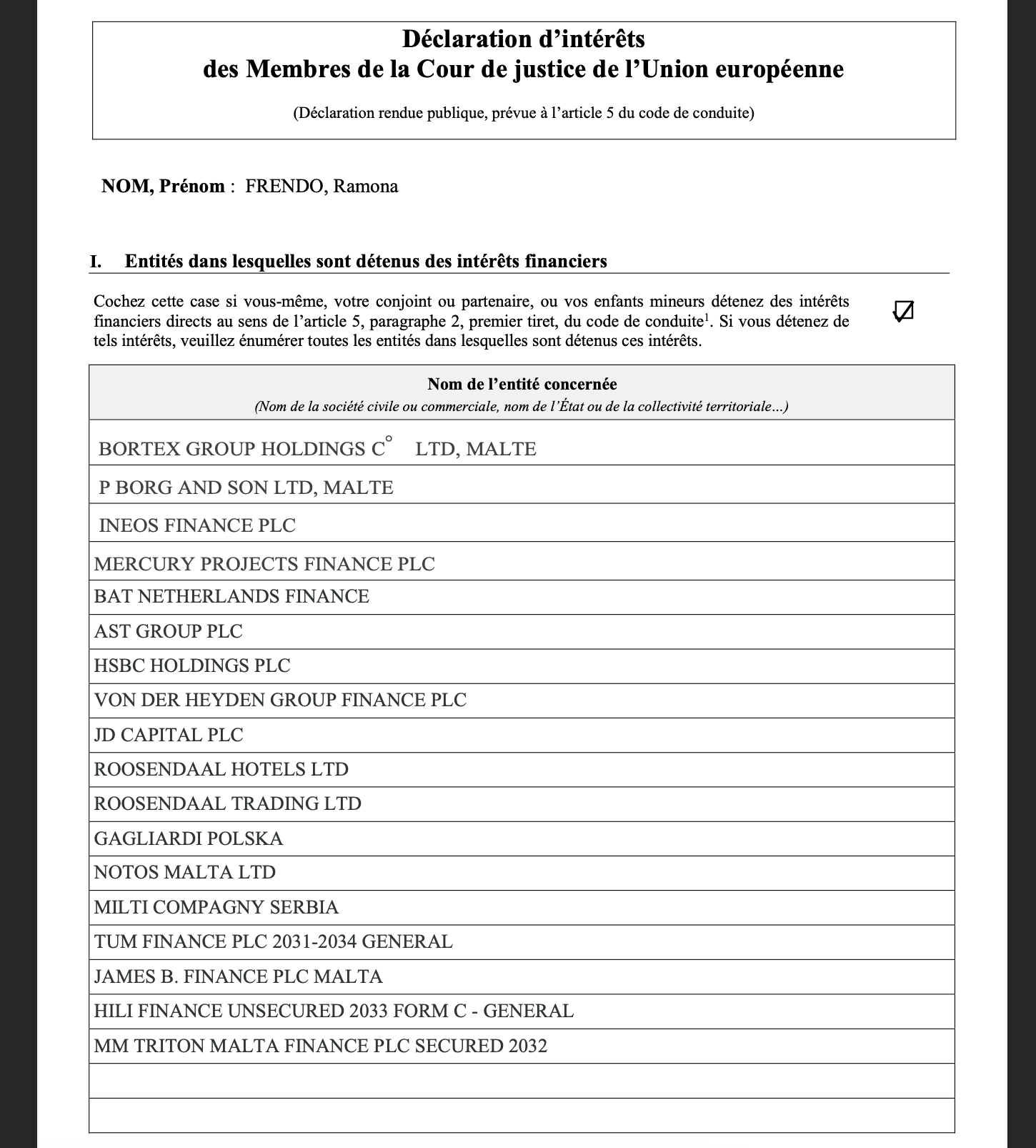
The latest declaration of interest (April 2026) published by Maltese jurist Ramona Frendo. Her 18 interests are the most currently declared by a CJEU member.
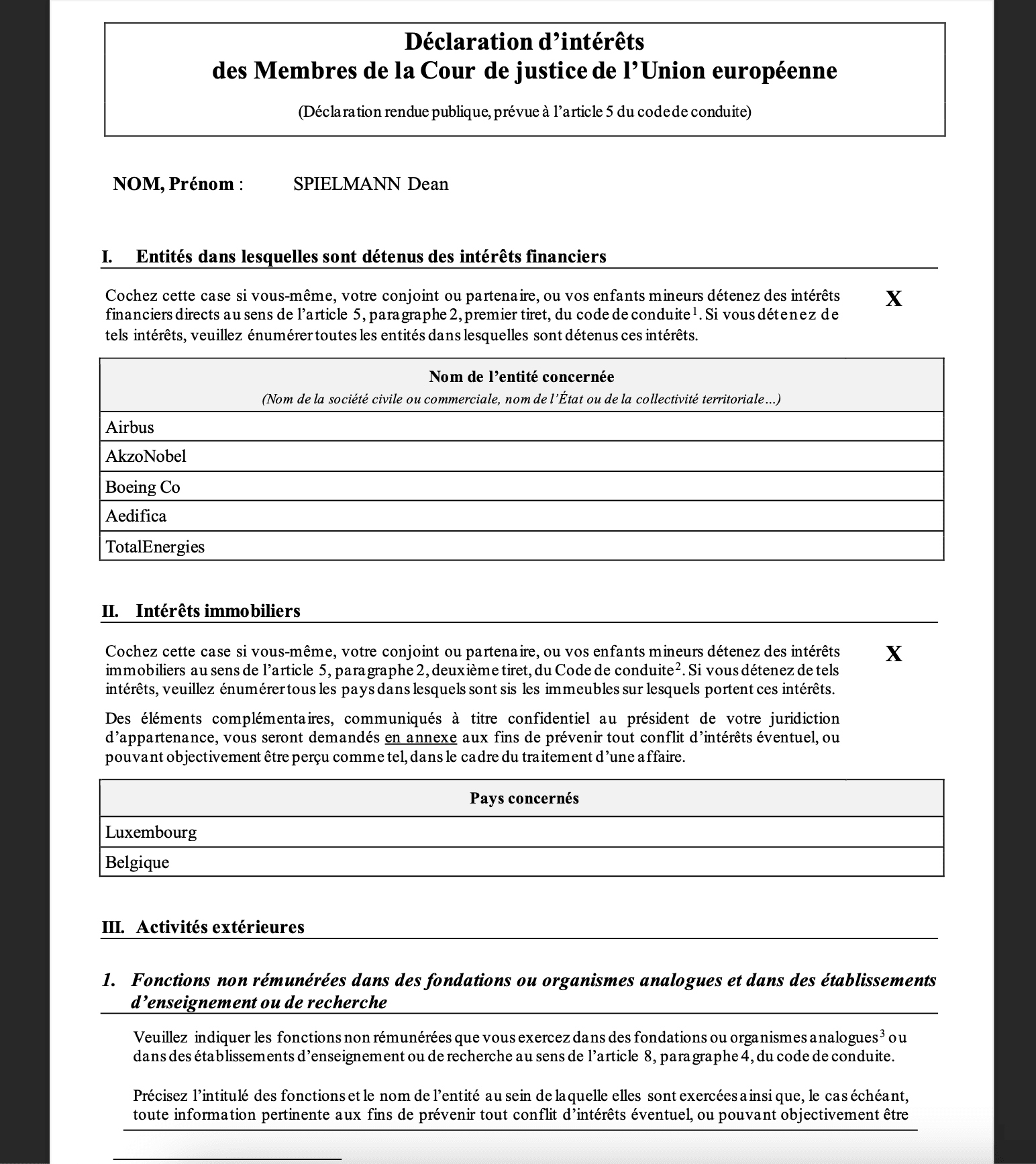
Luxembourgish judge Dean Spielmann declared interests in several major companies in his April 2026 filing.
The investigation, published with media including Le Monde, EUobserver, Le Soir and Follow the Money, could yet have further impact.
The President of the General Court, Marc van der Woude, said in the days before we published that the findings would be reviewed by an internal committee. Van der Woude said that he wanted to improve the system for checking potential conflicts of interest in case assignments, including, in particularly complex cases, with the help of artificial intelligence.
Marc Botenga, a Belgian MEP from The Left group, meanwhile, submitted a parliamentary question to the Council asking whether the appointment process for court members could be improved.
The European Ombudswoman, Teresa Anjinho, announced at the end of June that she would open an inquiry into the court’s failure to release historical declarations of its members.
Anjinho is expected to meet with court officials in mid-September to discuss the matter, which came after Investigate Europe filed an official complaint. It is unclear if the court’s move this week to release some previous declarations will have any impact on the inquiry.
The President of the General Court, Marc van der Woude, said in the days before we published that the findings would be reviewed by an internal committee. Van der Woude said that he wanted to improve the system for checking potential conflicts of interest in case assignments, including, in particularly complex cases, with the help of artificial intelligence.
Marc Botenga, a Belgian MEP from The Left group, meanwhile, submitted a parliamentary question to the Council asking whether the appointment process for court members could be improved.
The European Ombudswoman, Teresa Anjinho, announced at the end of June that she would open an inquiry into the court’s failure to release historical declarations of its members.
Anjinho is expected to meet with court officials in mid-September to discuss the matter, which came after Investigate Europe filed an official complaint. It is unclear if the court’s move this week to release some previous declarations will have any impact on the inquiry.
.jpg&w=3840&q=75)
Credit: Joanna Poupaki/Spoovio
The investigation was unusual in several ways. It was the first to systematically analyse the declarations of interest filed by CJEU judges and advocates general and compare them with the cases they had handled. Our first hurdle was the court’s website itself. Despite an expensive revamp, it is not even possible to search cases by a jurist’s name, for example.
To get around this, we worked with the IUROPA Project, a group of academics who have built the most comprehensive database of CJEU cases to date. They extracted tens of thousands of decisions covering the period from 1 January 2018 to 31 December 2024. We were then able to cross-examine the cases jurists had worked on with their declared financial interests.
It was painstaking work. Eventually we compiled a list of dozens of potentially problematic overlaps. These findings were reviewed by three experts with different backgrounds, all of them deeply familiar with the court. Some cases were discarded. Others were retained, making it into the final article.
The investigation also had limits. Because it relied primarily on declarations of interest and other publicly available information, it likely placed the spotlight on those who had been most transparent about their past and present activities. The more someone disclosed, the more visible they became.
Our findings should therefore not be read as a complete map of possible conflicts of interest inside the court. Rather, they are a documented account of what can be detected from the information the public is currently allowed to see.
To get around this, we worked with the IUROPA Project, a group of academics who have built the most comprehensive database of CJEU cases to date. They extracted tens of thousands of decisions covering the period from 1 January 2018 to 31 December 2024. We were then able to cross-examine the cases jurists had worked on with their declared financial interests.
It was painstaking work. Eventually we compiled a list of dozens of potentially problematic overlaps. These findings were reviewed by three experts with different backgrounds, all of them deeply familiar with the court. Some cases were discarded. Others were retained, making it into the final article.
The investigation also had limits. Because it relied primarily on declarations of interest and other publicly available information, it likely placed the spotlight on those who had been most transparent about their past and present activities. The more someone disclosed, the more visible they became.
Our findings should therefore not be read as a complete map of possible conflicts of interest inside the court. Rather, they are a documented account of what can be detected from the information the public is currently allowed to see.