The EU's new norm: Break democratic standards


In recent years, a gradual erosion of transparency has made the EU’s institutions harder to scrutinise. This is reflected in the massive backlog of unanswered requests, more restrictive rules, and even a legislative attempt to increase secrecy. However, journalists and transparency advocates continue to fight back against this opacity. Here are some crucial issues to watch out for in the year ahead:
This article is adapted from our bimonthly Secrecy Tracker newsletter, produced in collaboration with Follow the Money and EUobserver. This edition was co-written by Alexander Fanta (Follow the Money), Elena Sánchez Nicolás (EUobserver), and Pascal Hansens (Investigate Europe). Subscribe here to receive the next edition in your inbox.
#1 The information security threat
In our December issue, Nikolaj Nielsen (EUobserver) revealed ongoing efforts by legislators to drastically expand the classification of EU documents. This would “basically be the end of access to documents in the EU”, according to Transparency International EU’s Shari Hinds.
The bloc first proposed the Information Security Regulation, a law aimed at overhauling internal security measures, in 2022. One of its key provisions is the potential for “sensitive” labels to be slapped on many non-classified EU documents. What’s more, ordinary working papers could be made accessible only after a “need to know” test.
These restrictions could make it much harder for outsiders to participate in EU decision-making – even MPs in national parliaments fear they could be left out. The European Parliament and member states could decide on the issue later this year, with potentially wide-reaching consequences for the right of access to information.
We’ll be watching the legal process closely and reporting back on what happens next.

#2 Challenges to the Commission’s transparency rollback
The EU’s General Court is set to consider two challenges against new, restrictive “rules of procedure” on access to documents. These were put in place by the European Commission just days after Ursula von der Leyen began her second term in December 2024.
The revised rules significantly narrow the definition of which documents fall under the EU’s access-to-documents system. They also introduce a “general presumption of non-disclosure”, for broad categories of files, including legal opinions and anything related to the enforcement of EU tech laws. In practice, this makes many such records extremely difficult – if not impossible – to obtain.
These restrictions violate EU law and the Charter of Fundamental Rights, according to a lawsuit brought last year by former Parliament official Emilio De Capitani, legal scholar Päivi Leino-Sandberg, and the NGO Access Info Europe. They hope to overturn the rules and restore transparency.
A separate case brought by campaign group ClientEarth challenges how the new rules apply to environmental information. ClientEarth argues that the Commission’s restrictions are in breach of the EU’s commitment under the Aarhus Convention, which guarantees public access to such information.
The court has not yet set dates for hearings or rulings in either case. But both proceedings are expected to move forward over the course of this year.

#3 EU Ombudsman investigates tech laws blackout & revolving doors
The European Ombudsman is probing the Commission’s decision to impose a near-total information blackout on its enforcement of the Digital Services Act (DSA) - its flagship tech law - against the world’s largest tech firms.
The move has fuelled growing speculation that the Commission is slowing down – or even scaling back – its enforcement of the DSA and its sister tech law, the Digital Markets Act, to appease the U.S. Ombudsman.
In a November 2024 statement, EU Ombudsman Emily O’Reilly told the Commission that it had overreached with its blanket secrecy around the DSA.
Her successor, Teresa Anjinho, has since opened a new investigation following a complaint by Follow the Money. The trigger is the Commission’s refusal to reveal its exchanges with TikTok over alleged manipulation attempts during the 2024 Romanian presidential election. The complaint argues that the Commission failed to properly assess whether there was an “overriding public interest in disclosure”, as required under EU law and its own internal rules.
If transparency over measures designed to protect democracy doesn’t meet that threshold, critics ask, what does? The Ombudsman has already contacted the Commission and is expected to hold a formal meeting in the coming months.
She is also set to investigate the long-standing “revolving doors” phenomenon – where senior EU officials move into private sector roles – an issue with major implications for transparency, accountability, and trust in EU governance.

#4 Lawsuit targets von der Leyen over tech law U-turn after Vance meeting
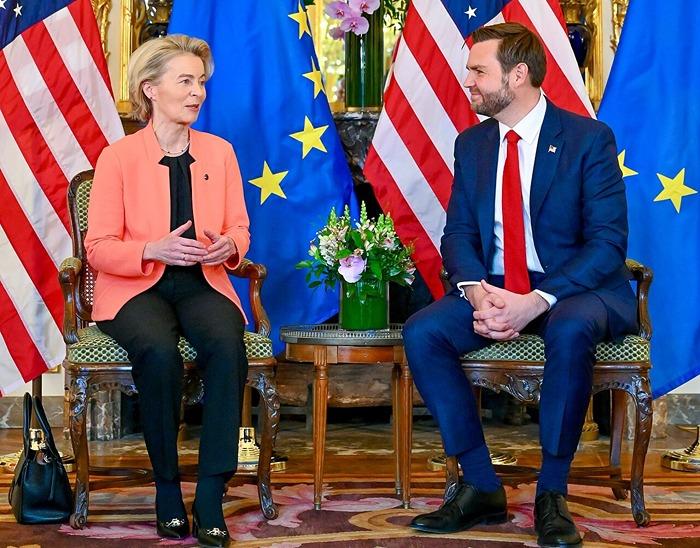
Last year, German MEP Tiemo Wölken secured an order from the EU’s General Court that could shed light on how Commission President von der Leyen decided to withdraw a draft EU tech law following apparent pressure from the Trump administration.
The Commission abruptly scrapped its proposed regulation on Standard Essential Patents (SEP), which could have saved EU firms billions of euros in patent fees paid to U.S. tech companies. Von der Leyen withdrew the law shortly after a meeting with U.S. Vice-President JD Vance, Wölken said.
But the MEP’s request for documents detailing the decision to retract the law hit a dead end. Now, his lawsuit – currently pending before the court – seeks access to e-mails and text messages exchanged by von der Leyen and her staff that could reveal what really happened behind closed doors.
#5 Texting at the top: von der Leyen’s messages back under scrutiny
The EU Ombudsman is set to investigate (once again) a topic that has dogged von der Leyen for years: how she handles – and withholds – her text messages.
The present case revolves around a text sent by French President Emmanuel Macron to the Commission chief about the Mercosur trade deal.
Implausibly, the Commission claims that the text was not sufficiently original to be kept and admitted deleting it after our co-author Alexander Fanta requested access. The Commission has never archived – or released – a single text message in response to an access-to-documents request.
That position – based on an increasingly popular notion that texts are “ephemeral” and therefore not worth keeping – is becoming harder to defend as texting emerges as the lifeblood of modern diplomacy.
Just days ago, U.S. President Donald Trump published texts from Macron about Greenland. Meanwhile, von der Leyen and leaders from 35 countries reportedly share updates on Trump’s attempts at world domination in a group chat called “Washington Group”. One is left to wonder how none of these messages could be worth keeping…
The Commission told the Ombudsman that it would, in principle, keep messages between von der Leyen and EU leaders – just not in the case of Macron’s Mercosur text.
But how freely should the Commission get to decide what it deletes, and what it keeps? The watchdog’s renewed probe could shed light on how the Commission manages digital communications at the highest levels, with huge implications for transparency – and perhaps for von der Leyen herself.
Other news
Journalists’ group steps up pressure on EU transparency
As criticism grows over shrinking transparency in Brussels, journalists and watchdogs have a new ally. The International Press Association (API-IPA) has launched a working group to confront what it calls “increasingly opaque EU institutions”.
Pascal Hansens, a co-author of this newsletter, will represent the group on API’s governing council. “In recent years, the Commission has shown less and less respect for the EU’s cornerstone Access to Documents regulation”, Hansens said in the group’s announcement.
For decades, API has acted as a quasi-official representative body for journalists dealing with European institutions. It also plays a role in accrediting journalists to the EU and NATO and serves as a regular point of contact between journalists and institutional spokespeople.
The new working group will address ongoing concerns about transparency, including months-long delays in responding to access requests, highly selective disclosures, and excessive redactions of documents.
“They often look like masterpieces,” Hansens said about such heavily redacted files. “Sometimes the freedom of information return is totally black, abstract. Sometimes it’s totally grey.”
Concerns about the Commission’s practices are mounting. Last year, an open letter – initiated by Follow the Money’s Alexander Fanta and Jean Comte of MLEx and signed by dozens of journalists from international media – warned of a decline in the Commission’s openness.
Fanta and Comte also set up an e-mail list for journalists (open to newcomers) to trade information and share grievances.
So far, the Commission has done little to address the concerns. According to official figures for 2024, its average time to answer appeals is 93 working days, far above the 30-day maximum mandated by law. This figure hasn’t improved in recent years.
Whether the new working group can translate pressure into change now remains to be seen.
MEPs vote to end the EU’s default secrecy culture
MEPs are calling for a major reset of the EU’s transparency regime, urging institutions to treat disclosure as the norm and secrecy as the exception.
Last week, in a new report adopted by the European Parliament’s civil liberties committee, MEPs called for faster and better-justified responses to document access requests, clearer rules on classification (and declassification), and earlier access to key policy and legislative documents.
The report also welcomes recent court rulings that reinforce transparency obligations, and urges EU institutions to improve document registers – making it easier for citizens to see what information exists in the first place.
MEPs note that the Commission withdrew earlier attempts (2008, 2011) to update access-to-documents rules, missing an opportunity to modernise the outdated system. They are now urging the Commission to propose new rules that limit exceptions and set higher EU transparency standards.
“Access to documents is a fundamental right of every EU citizen, but too often they face systemic delays, over-classification, and inconsistent proactive publication,” said the lead MEP in the file, Slovak liberal Veronika Cifrová Ostrihoňová.
“We need to ensure that transparency is the rule and secrecy the exception, ensuring timely access to documents, including ones related to legislation, trilogues and international agreements. I believe that transparency increases the trust of citizens in the EU,” she added.
The report is expected to go to a plenary vote next month.
If you come across any good examples of EU institutions dealing with transparency (or failing to!), let us know! And stay tuned for our next newsletter coming in September.
For any suggestions, examples, or complaints, email hansens@investigate-europe.org, alexander.fanta@ftm.nl or esn@euobserver.com
For any suggestions, examples, or complaints, email hansens@investigate-europe.org, alexander.fanta@ftm.nl or esn@euobserver.com