Secrecy Tracker | An open letter to a closed Commission: advocates demand transparency


Media organisations and press freedom groups have urged European Commission President Ursula von der Leyen to address growing barriers to public access to EU documents, warning that excessive redactions, lengthy delays and the failure to preserve records are undermining journalists’ ability to scrutinise the bloc’s institutions.
This article is adapted from our bimonthly Secrecy Tracker newsletter, produced in collaboration with Follow the Money and EUobserver. This edition was co-written by Alexander Fanta (Follow the Money), Elena Sánchez Nicolás (EUobserver), and Pascal Hansens (Investigate Europe). Subscribe here to receive the next edition in your inbox. We are back with a new issue of the Secrecy Tracker – your regular update on what the EU institutions prefer to keep under wraps.
Welcome back to a new issue of the Secrecy Tracker newsletter – which brings into sight what the EU institutions prefer to keep under wraps.
I am Alexander Fanta, a journalist with Follow the Money, who has for years struggled to gain access to EU documents. As always, this newsletter was written in collaboration with the EUobserver’s Elena Sánchez Nicolás and Nikolaj Nielsen, as well as Pascal Hansens from Investigate Europe.
Credit: Follow the money
Media outlets, journalist associations, and press freedom organisations published an open letter to European Commission President Ursula von der Leyen this morning to voice mounting frustration about the ongoing deterioration of the EU’s implementation of its freedom of information law.
The letter – which was co-signed by the publishers of this newsletter – urges the Commission to end the silent crisis that has hampered journalists finding the documents they require to scrutinise matters of public importance. Take just two examples: how member states misspent billions in post-COVID-19 recovery funds, or the Commission’s hidden arms research cooperation with Israel.
The signatories of the letter include press lobby groups such as the International Federation of Journalists, as well as some of the weightiest voices in investigative journalism – the International Consortium of Investigative Journalists and the Organized Crime and Corruption Reporting Project.
The leading figure behind the letter – the Committee to Protect Journalists’ Tom Gibson – has asked von der Leyen’s cabinet for a meeting to discuss these issues and seek improvements.
“The European Commission purports to uphold press freedom in Europe as well as through its external policy,” Gibson said. “Yet, in Brussels, we see that the European Commission is seeking to actually put obstacles in the way of creating an enabling environment for journalists who report on the institutions – in order, seemingly, to maintain an ability to control the official narrative.”
“This has to change, otherwise the European Commission can be accused of double standards”, according to Gibson.
The letter demands answers from the Commission over its excessive redactions on released files and over the long delays journalists face when seeking material under the bloc’s freedom of information law, Regulation (EC) 1049/2001. It also didn’t forget about the Commission’s failure to keep crucial documents. Case in point: von der Leyen’s texts with Pfizer chief Albert Bourla.
In 2024, the Commission controversially narrowed its definition of a “document”. This made it even harder to access entire areas of its work that are of critical public interest. Take how it enforces its Big Tech laws.
Last week, the European Ombudswoman, the bloc’s administrative watchdog, launched a probe into the EUobserver’s complaint against the Commission. The EU executive refused to release 17 documents on how the bloc spent public money on construction projects in Gaza.
The outlet first asked in February during an investigation into the extent of the Israelis’ damage of destroyed EU-funded infrastructure in the Gaza Strip. Journalists were stonewalled, amid arguments that there was “no overriding public interest” in the matter. Apparently, tens of thousands of deaths, Europe-wide protests, and flotillas don’t amount to enough public interest. The appeal went unanswered.
Now, Ombudswoman Teresa Anjinho is demanding – as a first step – a Commission response to the appeal by 4 November at latest. If the Commission still fails to deliver, Anjinho will review the documents herself.
The letter – which was co-signed by the publishers of this newsletter – urges the Commission to end the silent crisis that has hampered journalists finding the documents they require to scrutinise matters of public importance. Take just two examples: how member states misspent billions in post-COVID-19 recovery funds, or the Commission’s hidden arms research cooperation with Israel.
The signatories of the letter include press lobby groups such as the International Federation of Journalists, as well as some of the weightiest voices in investigative journalism – the International Consortium of Investigative Journalists and the Organized Crime and Corruption Reporting Project.
The leading figure behind the letter – the Committee to Protect Journalists’ Tom Gibson – has asked von der Leyen’s cabinet for a meeting to discuss these issues and seek improvements.
“The European Commission purports to uphold press freedom in Europe as well as through its external policy,” Gibson said. “Yet, in Brussels, we see that the European Commission is seeking to actually put obstacles in the way of creating an enabling environment for journalists who report on the institutions – in order, seemingly, to maintain an ability to control the official narrative.”
“This has to change, otherwise the European Commission can be accused of double standards”, according to Gibson.
The letter demands answers from the Commission over its excessive redactions on released files and over the long delays journalists face when seeking material under the bloc’s freedom of information law, Regulation (EC) 1049/2001. It also didn’t forget about the Commission’s failure to keep crucial documents. Case in point: von der Leyen’s texts with Pfizer chief Albert Bourla.
In 2024, the Commission controversially narrowed its definition of a “document”. This made it even harder to access entire areas of its work that are of critical public interest. Take how it enforces its Big Tech laws.
“No overriding public interest”: watchdog probes Commission’s Gaza secrecy
Last week, the European Ombudswoman, the bloc’s administrative watchdog, launched a probe into the EUobserver’s complaint against the Commission. The EU executive refused to release 17 documents on how the bloc spent public money on construction projects in Gaza.
The outlet first asked in February during an investigation into the extent of the Israelis’ damage of destroyed EU-funded infrastructure in the Gaza Strip. Journalists were stonewalled, amid arguments that there was “no overriding public interest” in the matter. Apparently, tens of thousands of deaths, Europe-wide protests, and flotillas don’t amount to enough public interest. The appeal went unanswered.
Now, Ombudswoman Teresa Anjinho is demanding – as a first step – a Commission response to the appeal by 4 November at latest. If the Commission still fails to deliver, Anjinho will review the documents herself.
Credit: Spoovio
Aarhus Convention vs. data centre secrecy
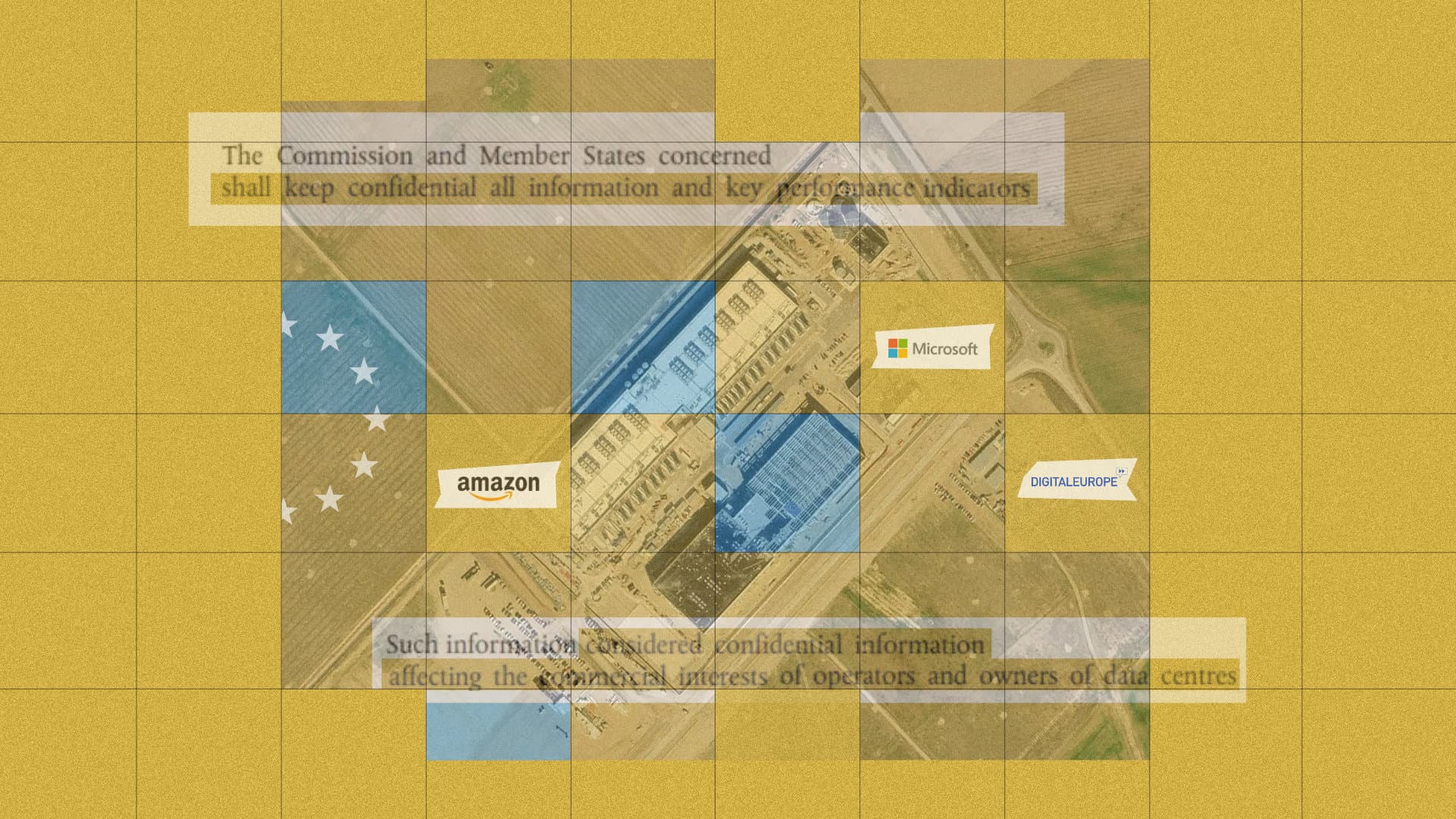
In April, Investigate Europe revealed that EU rules are keeping key information about data centres’ environmental impact secret. As we reported in this newsletter, this secrecy likely breaches transparency requirements under the Aarhus Convention, an international agreement on environmental rights. Now, Lighthouse Reports has reported that they’ve filed a formal legal challenge against the law. The frustration began when faced with repeated refusals from over a dozen EU member states and the Commission to access data on energy consumption by data centres across Europe.
Normally, these are collected under the Energy Efficiency Directive (EED). Lighthouse Reports decided last September to turn to the Aarhus Convention and its compliance committee. The binding treaty aims to protect transparency over environmental information. It’s often used as a last resort solution. Lighthouse Reports may face a long wait for a ruling though, as the process can take years.
Investigate Europe, Follow the Money, and other media partners will publish an investigation into another problematic side of Europe’s data centre boom tomorrow… stay tuned.

Credits: Spoovio
When EU’s top court challenges transparency watchdog’s authority
The Court of Justice of the European Union (CJUE) has challenged the European Ombudsman’s authority to investigate its refusal to disclose past financial declarations of interests of its judges and advocates general, according to a decision published by the EU’s transparency watchdog.
The dispute began after Investigate Europe reporters, while investigating judges’ currently declared financial interests, discovered that older declarations were no longer publicly available. The Court initially refused, arguing that those documents were judicial and not administrative ones, and therefore fell outside the rules on public access to documents.
Following our complaint to Teresa Anjinho and her subsequent decision to open an inquiry, the Court eventually agreed to release the requested former declarations, but only upon request. So the EU Ombudswoman closed the case, as she considered that the Court had rectified the problematic situation.
The EU Ombudswoman firmly rejected the Court’s interpretation: handling public access requests is an administrative activity, regardless of the nature of the documents concerned. She also called for greater clarity on how the Court distinguished between judicial and administrative documents.
Perhaps this can be seen as a small victory for transparency, but a broader question remains. Should the EU’s top court have such discretion over which of its own internal documents face public scrutiny?
For years, authorities shut the door. So we wrote a guide to opening it.
A new guide promises to give journalists (and anyone else) an easy introduction into making freedom of information requests in 39 European countries and with the EU. The first-of-its-kind handbook. It was created by the authors of this newsletter and with the help of 45 journalists, academics, and FOI advocates from around the continent. It is hoped that the guide can offer answers to practical questions like “how can I appeal” and provide contacts for people who can help in each country.
Find the guide published by the Arena for Journalism – free to use and share – in this link.